



When the Woman at the Well encounters Jesus Christ in John 4, she has a life-changing experience. Jesus offers this Samaritan woman at the well not merely natural, physical water—but the gift of God, living water, which he elsewhere teaches that his disciples first receive in baptism (John 3:3-5; Matt. 28:18-20)—an intimate, sacramental encounter with him which provides and leads to eternal life.
This Woman at the Well story unfolds between the Jews and Samaritans, groups divided by history and worship. (When the Assyrians overthrew in 722 B.C. the northern kingdom of Israel, located in the region of Samaria, they brought in foreign tribes to intermarry with the natives. Thus, in time, “the Samaritans,” who blended the imported heresy and idolatry with their God-given religion.) Yet, Jesus Christ and the woman at the well break through these barriers, because Jesus truly is God (John 1:1-3, 14; 14:6). What begins as a simple request for the woman to draw water for him becomes a moment of meeting Jesus Christ that transforms her life. The encounter reveals that no one is beyond God’s mercy and thus that every person is invited into a relationship with the Lord Jesus (see Acts 2:37-39; Luke 15:11-32).
Who Was the Woman at the Well in the Bible?
Many ask, who was the woman at the well in the Bible? While Scripture does not name her, Christian tradition recorded in the Roman Martyrology identifies her as St. Photina. The Bible woman at the well is not just a symbolic figure, but a real person whose encounter with Christ led to her conversion, a salvific conversion which Jesus desires for the whole world (1 Tim. 2:4).
As a Samaritan, she belonged to a group tragically separated from the Jewish people (see above). This makes the meeting of Jesus with the Samaritan woman at the well especially significant. Instead of avoiding her, Jesus speaks to her directly, revealing that the Catholic faith is for all people. Her story shows that God’s grace reaches beyond divisions and calls each person into communion with him (John 3:16; see 2 Pet. 3:9).
Where Is the Woman at the Well in the Bible?
The Woman at the Well Scripture passage is found in John 4:1–42. This passage, often called the woman at the well Bible scripture, describes Jesus at the well with the Samaritan woman as she comes to draw water during the heat of the day.
The setting itself carries meaning. The physical well represents temporary satisfaction, while Christ introduces a deeper reality—a spring of water leading to eternal life, which a disciple initially receives in baptism (Tit. 3:4-7; see Acts 22:16) Whether you read the Woman at the Well KJV (King James Version) or another biblical translation, the message remains consistent: human longing cannot be fulfilled by earthly things alone.
What Did Jesus Christ Say to the Woman at the Well?
The conversation between Christ and the woman at the well is one of the longest personal dialogues in the Gospels. Jesus answered her questions while gradually revealing deeper truths about herself and the divine relationship to which he was calling her.
He explains that earthly water satisfies only temporarily: “Every one who drinks of this water will thirst again” (John 4:13). But the living water Jesus offers satisfies completely, because he provides “a spring of water welling up to eternal life” (John 4:14). This exchange between Jesus and the Samaritan woman at the well reveals that Christ alone can fulfill the deepest desires of the human heart (John 14:6; 8:31-32).
Jesus also teaches that true worship in his New Covenant is not primarily about location but relationship. He calls her to worship God and thus worship the Father and him, pointing to a new way of encountering God rooted in grace and truth.
What Is the Meaning of the Woman at the Well Story?
The meaning of the Woman at the Well account centers on the human search for fulfillment and God’s response to it. The woman’s life reflects a longing for stability and love that has left her unsatisfied.
Rather than condemning her, Jesus Christ meets her with both mercy and truth. He acknowledges her past while offering a path forward. This encounter shows that conversion begins when we recognize our need for the Lord and accept the gifts he offers.
The Woman at the Well Jesus encounter reveals that true fulfillment is found not in temporary things but in relationship with Christ, who alone leads us to eternal life.
Why Did the Woman at the Well Have Five Husbands?
The Samaritan woman’s having had five husbands highlights her personal life struggles, which mirror how the Samaritans had historically intermarried with five different foreign tribes, thereby adding five different gods to their worship of the one, true God (see 2 Kings 17:24-31). Still, Jesus reveals this not simply to convict her—she was also cohabiting with yet another man at the time—but to manifest his divine knowledge and invite her to conversion in him (see John 8:31-32)
Her experience reflects the human tendency to seek fulfillment in mere human relationships and fleeting circumstances that cannot ultimately satisfy. Through the account of Jesus Christ and the woman at the well, we see that only Christ can meet the deepest needs of the human heart. His words bring her past into the light (see John 8:12), so that she can begin a new life rooted in truth.
What Does the Woman at the Well Teach Us About Worship?
A central teaching in the Woman at the Well story concerns true worship. The woman notes where she and her fellow Samaritans worship—alluding to Mount Gerizim as distinguished from the Temple in Jerusalem, and thus acknowledging the religious division between the Jews and Samaritans.
Jesus shifts the focus away from geographical locale and toward himself and the Father, fulfilled in the New Covenant Passover which we do “in remembrance of him.” He teaches us that authentic worship means to “worship the Father in spirit and truth” (John 4:23). This kind of worship is not limited to location but is rooted in a relationship with God.
For the Catholic Church, this teaching is fulfilled in Christ, especially in the Eucharist—the new Passover—in which believers fully worship the Father through Jesus.
What Can We Learn from the Women at the Well?
The example of the women at the well, especially the Samaritan woman at the well, shows how an encounter with Christ leads to profound transformation. After meeting Jesus, she leaves behind her water jar and returns to share her experience with others, who, in turn, are converted in encountering Jesus themselves (John 4:28-29, 39-42).
The woman at the well with Jesus becomes a fruitful witness, showing that encountering Christ leads supernaturally to sharing the Faith. Her story reminds us that God meets us in ordinary moments and calls us to something greater.
Ultimately, the woman at the well reveals that Christ earnestly seeks us, speaks to our deepest needs, and invites us into a life of grace that changes everything.
Free Download | Woman at the Well Prayer Card
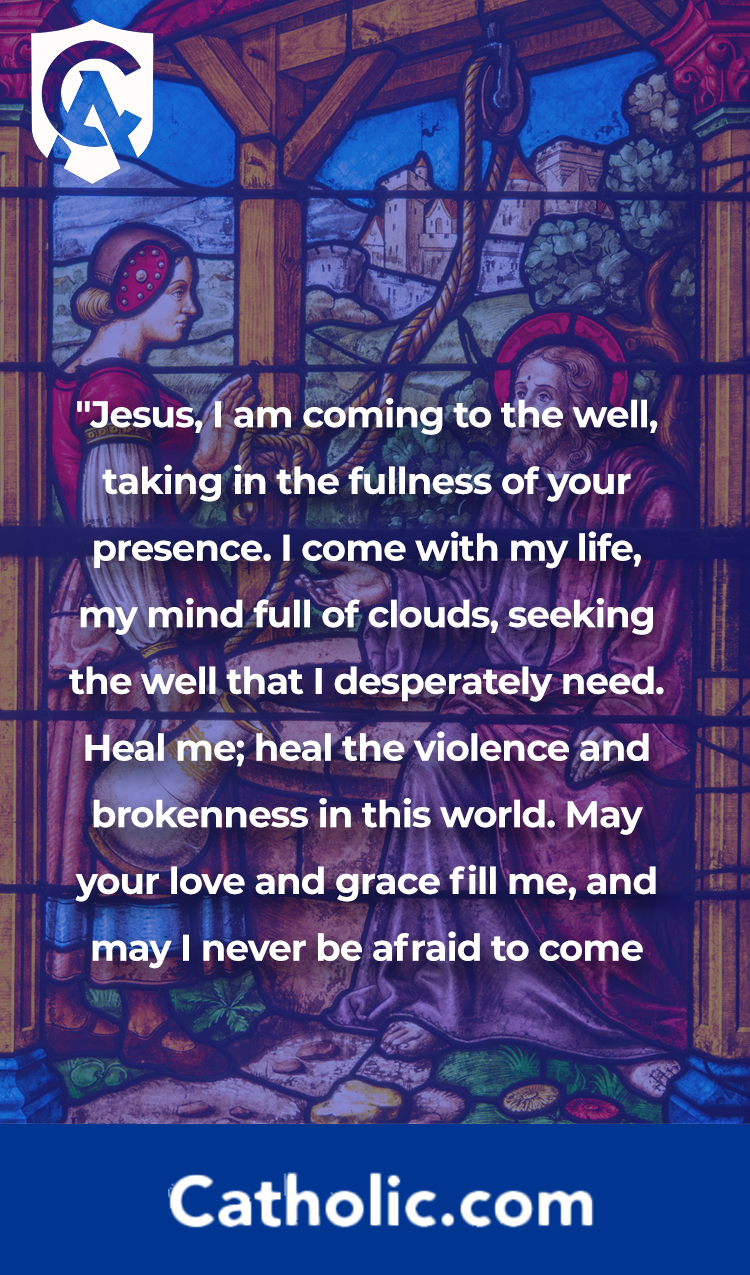
Commonly Asked Questions
- What is the main message of the woman at the well? Jesus offers us living water—grace that satisfies the soul and leads to eternal life, which the faithful normatively receive through the sacraments (see CCC 1257).
- Why did the woman at the well have five husbands? Her past reveals her struggles in search of personal fulfillment; Jesus Christ calls her to conversion and thereby fulfillment in him.
- What was the sin of the woman at the well? She lived outside God’s plan, through multiple marriages and unmarried cohabitation, but Christ meets her with mercy and truth.
- Where is the woman at the well in the Bible? The woman at the well in the Bible is found in John 4:1–42.
- What did Jesus tell the woman at the well? He offers the living water of life in him beginning in baptism, and he teaches worship of the Father in spirit and truth.
- What can we learn from the woman at the well? Through meeting—and embracing—Jesus Christ (see John 6:53-58), we receive grace, truth, and new life.
Related Content
Articles
Jesus and the Woman at the Well
Podcasts
Sex, Procreation, and Marriage
Q&As
St. Photina: the Woman at the Well
Shop
Made This Way: How to Prepare Kids to Face Today’s Tough Moral Issues