



What Is Religious Trauma?
Unfortunately, many individuals in their lifetime have experienced, or will experience, religious trauma, or “church hurt.” While painful personal experiences can shape the way we view Christ’s Church, it’s important to remember what it truly means to be a Catholic—and how to remain as one. Additionally, as awareness of mental health issues have grown, so has discussion about the ways harmful religious experiences can affect a person’s emotional and spiritual well-being.
Religious trauma refers to emotional, psychological and spiritual wounds that result from abusive, manipulative, or otherwise deeply unhealthy religious experiences. These wounds may come from spiritual leaders, family members, religious communities, and uncharitably shared—and/or distorted—teachings that misuse God’s name and mission to control, shame, or harm others.
While religious trauma occurs in both non-Christian and Christian settings, the Catholic Church recognizes that people can be—and have been—seriously wounded through the misdeeds of her members, including by the gravely sinful actions of some of her clerical leaders in the last several decades. Jesus repeatedly condemned religious leaders who burdened others, neglected mercy, or otherwise abused their authority:
They bind heavy burdens, hard to bear, and lay them on men’s shoulders; but they themselves will not move them with their finger (Matt. 23:4; see 23:1-36).
At the same time, it is important to distinguish between the failures and wrongdoing of Church leaders, whether clerical or lay, and the liberating truth of Christ and his saving gospel message (John 14:1-16: see 8:31-32)—as well as how Jesus promised to safeguard his Catholic Church and the saving mission he gave her from destruction, despite external attacks and internal scandals (see Matt. 16:18-19). Indeed, Christ came to heal the brokenhearted—not inflict injustices on them (Luke 4:18).
What Causes Religious Trauma?
Many people searching online ask, what causes religious trauma or what counts as religious trauma?
While most unpleasant experiences in religious settings are not traumatic, a large number have been and can be. In addition, Christ’s teachings are challenging (e.g., John 6:60; Matt. 5—7; Matt. 19:1-10); still, they must always be communicated with love (Eph. 4:15). In that light, sharing the gospel in charity is not abusive, but failing to share it with Christlike love is wrong.
Authentic religious trauma may result from experiences such as:
- Spiritual manipulation or coercion.
- Emotional, physical, or sexual abuse by religious leaders.
- Using Scripture to justify abuse or control.
- Shame or fear used to force obedience.
- Isolation from family or other healthy relationships.
- Threats which convey that any questioning of leaders means questioning or rejecting God.
- Covering up abuse in the name of protecting the Church or in other religious communities, whether Christian or non-Christian.
These behaviors contradict Catholic teaching and the natural moral law in general. The Church condemns every form of religious abuse—whether by Catholic leaders, other Christians, or non-Christian leaders. Regarding her own God-given mission, the Church teaches that those entrusted with spiritual authority must imitate Christ, the Good Shepherd, who lays down his life for his sheep (John 10:11). Consequently, those leaders must protect children in their flock as their very own, which spiritually they are (see Matt. 18:1-4).
What Does Religious Trauma Look Like?
Many people wonder, what does religious trauma look like? Or they search for signs of religious trauma and religious trauma symptoms.
Someone experiencing religious trauma symptoms may struggle with:
- Fear of God based solely on punishment rather than filial love.
- Anxiety when entering a church or hearing religious language.
- Feelings of shame or worthlessness.
- Panic surrounding prayer or worship.
- Confusion or distrust about God.
- Isolation from supportive relationships.
These symptoms are real and deserve compassion and Christ’s healing love. However, they are not unique to religion. Similar symptoms can—and do—result from many forms of abuse or betrayal in non-religious settings.
For anyone who has experienced religious trauma within the Church, the answer is not to reject religion altogether, but rather to seek healing from Jesus through faithful ministers in his Church, as well as possibly licensed counselors who are faithful Catholics or at least respectful of your Catholic beliefs.
Religious Trauma Examples
People frequently search for religious trauma examples because they want to know whether others have endured the same or similar experiences they have.
Examples within various religious settings may include:
- A child who is often told the mistakes he makes and/or sins he commits greatly disappoint God.
- A victim of religious abuse who is pressured to remain silent to protect a ministry, including the larger mission of the Catholic Church, as sadly many sexual abuse victims (and their parents) were told in recent decades past.
- Parents who manipulate their children by falsely claiming that every disagreement—or many of them—constitute sinful rebellion against them and God.
- A religious leader who uses fear, humiliation, or public shaming to maintain his authority.
Each of these behaviors, to one extent or another, betrays authentic Christianity—and the moral law in general, which is written on every human person’s heart (see Rom. 2:13-16).
Jesus welcomed sinners with mercy, while also calling them to repentance. He never manipulated people through fear to increase or safeguard his own power.
What Is Religious Trauma Syndrome?
You may also encounter the term religious trauma syndrome.
This phrase has been coined by some licensed mental health professionals to describe a collection of emotional and psychological difficulties that can result from harmful religious experiences. Unlike many recognized mental health diagnoses, religious trauma syndrome is not an official diagnosis in the Diagnostic and Statistical Manual of Mental Disorders (DSM).
Still, many people use the phrase to describe genuine suffering. Whether or not someone uses this particular label, related wounds deserve to be taken seriously.
Catholics recognize that God’s grace works in concert with sound therapy and genuinely supportive fellowship. Indeed, healing often involves both spiritual renewal within a supportive environment and sound mental health support.
Healing From Religious Trauma
Perhaps the most important question people ask regards how to heal from religious trauma.
Healing from religious trauma usually takes time. Recovery often involves addressing both emotional wounds and spiritual misunderstandings, including distinguishing between Jesus and his authentic Catholic Church from the leaders and others who betray Christ and his Church’s mission.
Helpful steps include:
- Seeking counseling from a qualified mental health professional.
- Finding a healthy Christian community—ideally, a Catholic parish—in which abuse is neither ignored nor tolerated.
- Learning the difference between abusive authority and authentic Christian leadership.
- Spending time meditating on Scripture, especially passages revealing Christ’s mercy.
- Receiving the sacraments when one is ready and able.
- Allowing trusted friends, counselors, and clergy to accompany you in the healing process.
Many people also search for religious trauma therapy or therapy for religious trauma. Professional counseling can be an important part of recovery, especially when abuse has occurred. Legitimate therapy is not opposed to the Faith. In fact, many faithful Catholics work as licensed therapists, psychologists, and psychiatrists who help people recover from trauma.
God desires healing for every wounded person. Psalm 147:3 reminds us, “He heals the brokenhearted, and binds up their wounds.”
Does the Catholic Church Cause Religious Trauma?
Some critics argue that Christianity itself is the cause of religious trauma. But the Catholic Church makes an important distinction.
Whenever Christians abuse others, they gravely betray the teachings of Jesus Christ and his Catholic Church, inclusive of the salvific mission he gave his Church (see Matt. 28:18-20). They do not act in accord with those teachings and divine mandate.
An example of such a grave betrayal is the clerical sexual abuse scandal of recent decades. Those who have perpetrated this scandal will have to render a serious account to our Lord Jesus for causing “these little ones who believe in me to sin” (Matt. 18:6; see 18:1-7; Jer. 23:1-4).
Still, please don’t let anyone or anything keep your from encountering our merciful Lord Jesus and the healing balm he ministers to us through his Catholic Church, beginning with the salvific sacraments he instituted.
If you have been sexually abused by a Church leader, or have had a loved one(s) who’s been abused, then Jesus and his Catholic Church are mercifully here to recognize how you’ve been gravely betrayed, accompany you in the healing process, and help fully restore your fellowship in the Lord Jesus and his authentic Church. Please be open to that long-term, merciful, and healing accompaniment, and you’ll receive affirmative reminders that what you have experienced is indeed a grave betrayal of Jesus and the mission he gave to his Church.
Catholicism is fundamentally about encountering our merciful Lord Jesus Christ within the divinized family of his Church, the new and fulfilled kingdom of Israel—and even amidst the grave moral failure of her human leaders. So, again, please don’t let the serious moral failures of a priest, bishop, and/or other Catholic leader/role model keep you from encountering our merciful Lord Jesus, and, in time, experiencing the healing and peace which the world cannot give (John 14:27; see Phil. 4:6-7).
The solution to spiritual abuse is not abandoning Jesus, but rather returning to the Lord in the heart of his Church, so that we may all be one in him and the Father, as Jesus prayed (see John 17:20-23).
Just as medical malpractice does not disprove the validity of medicine, religious abuse does not prove Christianity is false. Instead, it shows how fallen human leaders are prone to moral failure, including grave moral failure, and how desperately every person—including religious leaders—need conversion in Christ.
Statistics of People With Religious Trauma
Many people search for statistics regarding people who have experienced religious trauma, hoping to find clear data.
At present, there is no universally accepted metric that measures how many people have experienced religious trauma. Researchers use different definitions, study different religious groups, and measure different kinds of experiences.
What is clear is that religiously related abuse is real. The Catholic Church acknowledges this reality and continues working to prevent abuse, support victims, and hold offenders accountable.
In addition, every person’s experience deserves to be heard with compassion rather than dismissed or minimized.
Finding Hope After Religious Trauma
If you’re asking, “Do I have religious trauma?” know that you are not alone.
If you have been harmed by someone acting in God’s name, that harm should never be excused or downplayed.
At the same time, again, the failures of Christians are not the measure of Jesus Christ and the Catholic Church he founded and promised he would sustain through his Second Coming and the Last Judgment (Matt. 28:18-20).
Jesus invites every wounded person: “Come to me, all who labor and are heavy laden, and I will give you rest” (Matt. 11:28).
The Catholic Church proclaims a Savior who became man, experienced betrayal, injustice, and violence on our behalf, and then who rose again in victory over sin, death, and the devil to bring us healing and hope. Whatever wounds you have experienced, Jesus desires to heal and restore you.
If you or a loved one has questions regarding the Catholic Faith, Catholic Answers welcomes your questions with gentleness and grace. Call 1-888-31-TRUTH, Monday-Friday from 3pm-5pm PST.
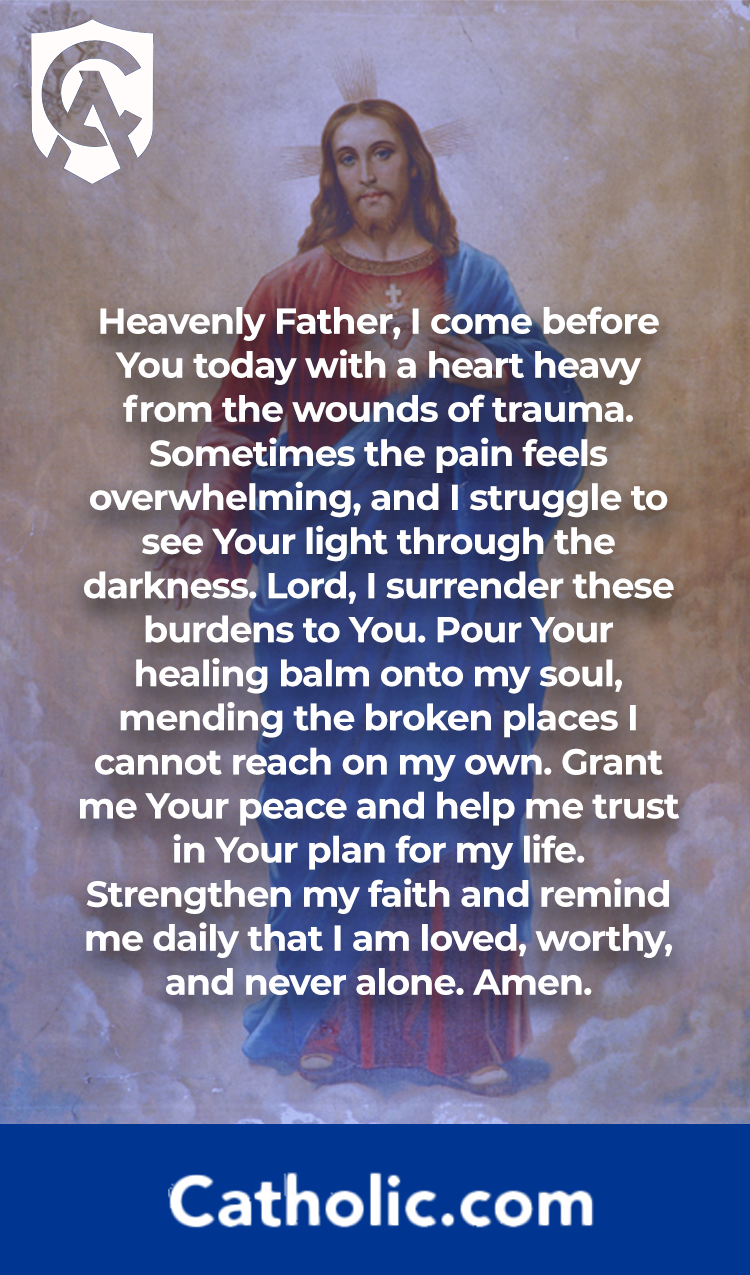
Downloadable Prayer Card | Religious Trauma
Commonly Asked Questions
- What is religious trauma? Religious trauma is emotional, psychological, and/or spiritual harm that results from abusive or unhealthy religious experiences and/or environments.
- What causes religious trauma? Religious trauma may be caused by spiritual abuse, manipulation, coercion, shame-based teaching, or other forms of abuse committed in religious settings, including sexual abuse.
- What does religious trauma look like? Common signs of religious trauma include shame, fear and anxiety regarding religion, difficulty trusting spiritual leaders, and confusion about and alienation from God.
- What are examples of religious trauma? Common religious trauma includes spiritual manipulation, abuse by religious leaders (including sexual abuse), coercive control, and using Scripture to justify harmful behavior.
- Do I have religious trauma? A licensed mental health professional can help you evaluate your individual circumstances, yet persistent emotional distress connected to harmful religious experiences should be discussed with a licensed therapist and/or trusted spiritual advisor.
- How to heal from religious trauma? Healing from religious trauma typically involves prayer, supportive Christian community, professional counseling, and—in the process—gradually discovering (or rediscovering) the mercifully loving divine Person of Jesus Christ.
- What is religious trauma syndrome? Religious trauma syndrome is a term used by some licensed mental health professionals to describe emotional, psychological, and/or spiritual wounds resulting from harmful religious experiences. It is not an official mental health diagnosis, but it is commonly used to describe a real pattern of suffering.
- Should I seek therapy for religious trauma? Yes, you should consider it. Religious trauma therapy or therapy for religious trauma can be an important part of healing, especially when serious abuse or manipulation has occurred.
Related Content
Articles or Tracts
St. Dymphna – Patron Saint of Mental Illness
Podcasts
The Worst Reason to Leave Catholicism
If God Exists, Why Do I Suffer?
I Left Catholicism Because of Church Scandals
Q&As
How Can I Make Emotional Sense out of Suffering When it Happens?
Understanding the Priest Scandal
Shop
20 Answers: Anti-Catholic Myths
Salvation Is from the Catholic Church: How Christ Uses the Church to Bring Us to Him
Light From Darkness: Nine Times the Church Was in Turmoil, and Came Out Stronger Than Before