



Who Was Saint Valentine?
While the details of Saint Valentine’s life are founded more on legend than historical fact, there is good evidence that the Christian faithful in the early Church actually venerated a saint of this name. Two St. Valentines are listed for February 14 in the Roman Martyrology, which dates to the late 1500s. One was a Roman priest who was martyred on the Flaminian Way in the latter third century, while the other was a third-century bishop of Terni in Italy, which has become known as the “city of love” given its association with the saint. Some scholars believe these two may have been the same person, while others think more than one St. Valentine existed. Because details of Valentine’s life are historically sketchy, Pope St. Paul VI removed him from the universal liturgical calendar in 1969, and the Church now principally celebrates the feast of SS. Cyril and Methodius on February 14. Still, on this same day, St. Valentine’s feast remains an optional one for which priests can celebrate the sacrifice of the Mass, depending on the local liturgical calendar and a priest’s pastoral judgment. So St. Valentine remains a prayerful intercessor for the faithful, one who is remembered as a crusader of love, especially love of God and neighbor (see 1 Cor. 12–13).
In summary, St. Valentine’s feast day remains February 14, although in modern times, sadly, the day has become much more known for the secular celebration of Valentine’s Day.
Why Was Saint Valentine Martyred?
Saint Valentine lived during the reign of the Roman Emperor Claudius II. One account says that he secretly married Christian couples, defying Claudius’s ban on marriage for young men, because the emperor believed unmarried men made better soldiers. Another story tells of Valentine restoring sight to a jailer’s blind daughter, which led to her whole family converting to Christianity and the emperor consequently ordering Valentine’s execution after he refused to renounce his Christian faith. Soldiers beat him with clubs and then beheaded him outside the Flaminian Gate on February 14, 269. Legend holds that, before his death, he left a note to the girl he had healed, signing it, “From your Valentine.” Though these stories are legendary, they emphasize his courage of faith and his beautiful, outward expression of love for God and his neighbor.
When Is Saint Valentine’s Feast Day?
St. Valentine’s feast day is February 14, known today as Valentine’s Day. Pope Gelasius I officially established the feast in 496, stating that all of the facts of Valentine’s life are “known only to God.” The pope reportedly chose the date, in part, to redirect attention from the pagan Roman festival of Lupercalia (February 15), which was impurely amorous. Among other early Church evidence, Valentine is noted in the Depositio Martyrum, which dates at least back to 354.
Over time, people associated February 14 with love and courtship, partly because medieval Europeans believed that birds began to pair on this date. Writers such as Geoffrey Chaucer immortalized the connection, e.g., Chaucer in his fourteenth-century poem, The Parliament of Fowls, in which he describes birds choosing their mates on St. Valentine’s Day. Despite these associations, the Catholic Church does not teach that Valentine’s Day is meant to celebrate romantic love, but rather a day on which to commemorate St. Valentine’s life as a saint and martyr.
Why Is Saint Valentine the Patron Saint of Lovers?
Saint Valentine is honored as the patron saint of lovers, marriages, and engaged couples. Some traditions also link him to beekeepers and as a special intercessor for those suffering from epilepsy.
St. Valentine’s courage, compassion, and dedication to Christ’s Church remind Catholics that true love reflects the love of God: patient, kind, temperate, selfless, and humble. Even though the modern celebration emphasizes cards, chocolates, and flowers, the saint’s example shows that real love is sacrificial, inspired by Christ our Savior (see John 15:13; Eph. 5:25). As a line from the old marriage rite captures well: “Sacrifice is usually difficult and irksome. Only love can make it easy; and perfect love can make it a joy.”
The Dark Side of Valentine’s Day
In modern times, St. Valentine’s Day has been commercialized. Some of that is fine, if it celebrates true love through the giving of roses, cards, and/or taking someone out to dinner. On the other hand, there is often the celebration of lust, not love, and the promotion of even pornified media, like the movie Fifty Shades of Grey and other unsavory fare. As a result, the Christian meaning behind the feast day is often lost—similar to Halloween. Secular culture emphasizes romantic, or even erotic, love that—depending on the context in which it takes place—can obscure or contradict the spiritual significance of the feast, thereby deadening our understanding of what true love is: to will the genuine good of another. When people ask about the ancient dark side of Valentine’s Day, they are likely referring to the pagan Roman festival of Lupercalia, a fertility rite which honored the gods Romulus and Remus.
During her history, the Catholic Church has prudently sought to sanctify and/or redirect certain pagan customs wherever possible, guiding people to a faithful life in our Lord Jesus Christ instead of needlessly imposing burdens on prospective converts (see Acts 15:28). As our Lord Jesus himself counsels, “Behold, I send you out as sheep in the midst of wolves; so be wise as serpents and innocent as doves” (Matt 10:16). Karl Keating, the founder of Catholic Answers, gives examples of the Church’s evangelistic prudence:
Once, in a debate with a prominent anti-Catholic controversialist, I asked, “Are you married? Yes, I know you are. And when you were married, was your bride wearing a white gown, and did she carry a bouquet of flowers? You say she did. And did the two of you exchange vows and then rings? You’re nodding your head. Well, it seems that in your marriage ceremony you engaged in four pagan acts, since the white gown, the bouquet, the vows, and the ring are all taken from pre-Christian pagan rites. Are we to conclude that your brand of Christianity is pagan at its roots?” My opponent smiled and promptly changed the subject.
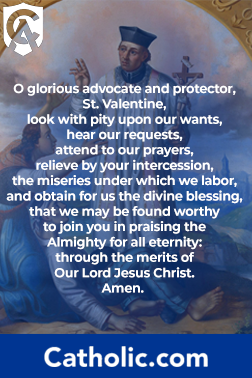
Free Download | St. Valentine Prayer Card
O St. Valentine, faithful servant of Christ, help us to love as you loved. Guide our hearts to cherish true, lasting love that is grounded in faith. Inspire courage, patience, and kindness in all our relationships. Be our Valentine, that we may honor God in our love today and always. Amen.
More Than Chocolates and Telegrams
Whether St. Valentine was a healer or a secret champion of Christian marriages, he challenges us to love boldly. His martyrdom under Claudius II and his devotion to Christ show that true love is inseparable from faith lived out (Gal. 5:6). As Catholics, we can reclaim Valentine’s Day as one not only to honor St. Valentine in heaven, but also to reflect on love that is charitable, upright, and eternal.
St. Valentine, pray for us!
Commonly Asked Questions
- Why do we eat chocolate and give gifts on Valentine’s Day? Chocolate on Valentine’s Day grew from medieval love tokens, with sweets and gifts reflective of Valentine’s patronage of lovers.
- Is Valentine’s Day Pagan? Valentine’s Day isn’t pagan. In part, Pope Gelasius may have set Valentine’s feast day to replace Roman excess with Christian love and witness.
- Was Saint Valentine gay? Claims that Saint Valentine lived a homosexual lifestyle have no historical basis. History points to a Roman priest martyred for the Faith under Emperor Claudius II, who reigned from 268-270.
- Is Valentine’s Day a holy day of obligation? No, Valentine’s Day isn’t a holy day of obligation. However, in honor of the saint on his feast day, Catholics may celebrate Valentine’s Day by participating in Mass and other edifying activities.
Related Content
Articles
Is Love a Choice or a Feeling?
Podcasts
A New Argument for Praying to the Saints
Q&As
How Does the Church Define Love?
Shop
20 Answers: The Communion of Saints