



What Is the Immaculate Heart of Mary?
The Immaculate Heart of Mary (IHM) is a Catholic devotion that honors the Blessed Virgin Mary’s heart, which symbolizes her profound interior life: her love for God in general (Luke 1:47-55) and her divine Son Jesus Christ in particular (Luke 1:30-38); her overall holiness; and her maternal love for us, her spiritual children (Rev. 12:17).
Consequently, devotion to the Immaculate Heart is not simply devotion to Mary’s physical heart, but what her heart represents: the exalted human person of Mary, especially her joys and sorrows, her virtues, her obedience to God, and the extraordinary love with which she loved her Son.
The Church’s devotion to Mary’s Immaculate Heart does not terminate in the Blessed Mother, but rather is ordered toward deeper fellowship with her divine Son. As Pope St. John Paul II explained well, Mary’s maternal love and holiness are inseparable from her role in the mission of her Son. Indeed, Mary always does God’s will (Luke 1:38), and so she always leads us closer to Jesus as his disciples (John 2:5).
What Does the Immaculate Heart of Mary Symbolize?
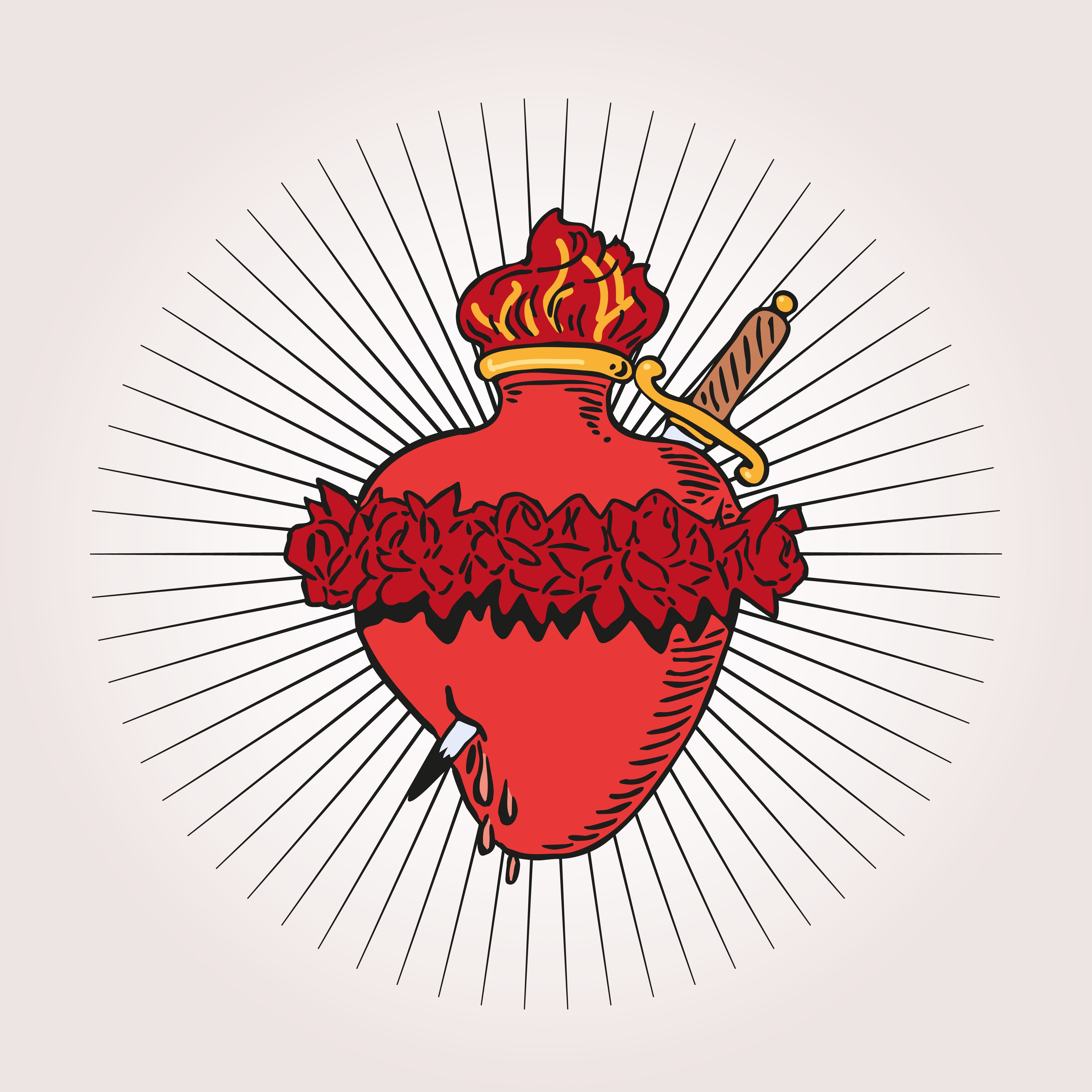
The Immaculate Heart of Mary symbolizes Mary’s love for God, in particular her divine Son Jesus, as well as her holiness and maternal love for humanity.
Scripture repeatedly draws attention to Mary’s heart. St. Luke tells us that Mary kept the events surrounding her Son’s birth and pondered them in her heart (Luke 2:19). After finding the twelve-year-old Jesus in the Temple, Mary again kept these things in her heart (Luke 2:51). Simeon also foretold that a sword would pierce Mary’s soul (Luke 2:35), a prophecy associated with her future agony alongside Jesus as he suffered and died for us.
Mary’s heart is often shown burning with love and pierced by a sword, recalling both her ardent love and the sorrows she endured as the Mother of Jesus. Traditional depictions may also surround the heart with roses.
Why Is Mary’s Heart Called Immaculate?
The word “immaculate” means “without blemish.” (In Latin, the masculine form is immaculatus and the feminine is immaculata. And that’s why the Blessed Mother is known as the Immaculata.) Mary’s heart is called immaculate because Mary herself was preserved from original sin by God’s grace, and because she remained free from personal sin—in cooperation with God’s grace—throughout her earthly life. (Many mistakenly think the Immaculate Conception refers to the conception of Jesus in Mary’s womb. Still, Jesus is sinless by nature as God, whereas Mary was conceived without sin as a divine gift, because in the Father’s plan this blessing was most fitting, given Mary’s vocation to become the Mother of God at the Annunciation.) The Angel Gabriel’s greeting to Mary at the Annunciation, “Hail, full of grace” (Luke 1:28), provides scriptural basis for Mary’s Immaculate Conception and life of sinless holiness, as do her being the ark of the New Covenant and the New Eve (see Rev. 11—12).
Catholics speak of the Sacred Heart of Jesus and the Immaculate Heart of Mary. The two devotions are closely connected, but they are not the same. The one is rightly ordered to the other, because Mary is a creature and disciple par excellence, whereas Jesus is the Creator and Savior of the world.
Jesus is the Son of God made man, and Catholics adore his Sacred Heart as the heart of the Divine Redeemer. Mary is a human creature redeemed by Christ. Catholics do not worship Mary; we honor her Immaculate Heart because of her unique holiness and her humanly perfect love for God.
Devotion to Mary’s Immaculate Heart—and to the Blessed Mother in general—is meant to help us lead more committed lives as Christ’s disciples, and Scripture affirms that Mary is divinely given to us as a spiritual mother (Rev. 12:17). Thus, the object of true Marian devotion does not stop with the Blessed Mother, but rather is ordered toward helping us become better Christians: by imitating her virtues, asking for her intercession, and uniting ourselves to her in wholehearted love of—and service to—her Son, our Lord Jesus Christ.
Where Did Devotion to the Immaculate Heart of Mary Come From?
Although formal devotion developed gradually, its roots are found in Scripture and otherwise in reflections on Mary in the early Church.
Christians were especially drawn to the Gospel passages concerning Mary’s heart, including her contemplation of Christ’s words and actions, as well as Simeon’s prophecy that a sword would pierce her soul. Devotion became more explicit during the Middle Ages, including with SS. Bernard of Clairvaux, Thomas Becket, and Gertrude.
During the seventeenth century, St. John Eudes played an especially important role in spreading public devotion to the hearts of Jesus and Mary. A feast honoring the Heart of Mary was celebrated at Autun, France, in 1648 through his efforts. Devotion to both Hearts accelerated through the casting and promotion of the Miraculous Medal beginning in 1832, a fruit of the Blessed Mother’s Church-approved apparitions to St. Catherine Laboure.
Pope Pius XII later established the celebration of the Immaculate Heart of Mary for the universal Church, fixing it at August 22. More recently, Pope St. Paul VI moved it to the day following the Solemnity of the Sacred Heart of Jesus. Meanwhile, August 22 remains a Marian feast in the Church’s newer liturgical calendar that Paul VI promulgated in 1969: the Memorial of the Queenship of the Blessed Virgin Mary.
The Immaculate Heart of Mary and Our Lady of Fatima
Devotion to the Immaculate Heart became particularly associated with Our Lady of Fatima following her apparitions to Lucia dos Santos and her cousins SS. Francisco and Jacinta Marto, which took place in Portugal in 1917 and which the Church later approved.
In the message of Fatima, devotion to Mary’s Immaculate Heart is closely connected with prayer, penance, conversion, reparation, and peace in our becoming more fervent disciples of her divine Son Jesus. The Fatima message specifically calls for devotion to the Immaculate Heart, an act of reparation expressed through the Five First Saturdays Devotion, which includes reception of our Eucharistic Lord Jesus in Holy Communion.
Far from presenting Mary as an alternative to Jesus, the Church rightly conveys the Immaculate Heart devotion as ordered toward him. Pope St. John Paul II described Mary’s Immaculate Heart as a refuge and a way that leads to Christ.
Other saints known for their devotion to the Immaculate Heart of Mary include St. Maximilian Kolbe, who founded the Militia of the Immaculate, and St. Anthony Claret, the founder of the Claretians.
When Is the Feast of the Immaculate Heart of Mary?
The feast day of the Immaculate Heart of Mary is celebrated on the Saturday following the Solemnity of the Sacred Heart of Jesus.
In 2026, the Immaculate Heart of Mary falls on Saturday, June 13. Because June 13 also coincides with the Memorial of St. Anthony of Padua in 2026, the Immaculate Heart is observed as an optional memorial in the dioceses of the United States for 2026.
The placement of these celebrations beside one another emphasizes the close relationship between the Sacred Heart of Jesus and the Immaculate Heart of Mary: the love of the Son and the love of his Mother, perfectly united in obediently carrying out the Father’s plan for our eternal salvation.
August: The Month of the Immaculate Heart of Mary
In traditional Catholic devotion, August is the month of the Immaculate Heart of Mary. The month provides Catholics with a particular opportunity to meditate on Mary’s interior life and imitate her love for her divine Son, her obedience to the Father’s vocation for her life, and her purity, prayerfulness, and other virtues in general. The association with August is also rooted in Mary’s Assumption into heaven, body and soul, at the completion of her earthly life, a solemnity the Church celebrates on August 15.
Catholics can honor the Immaculate Heart through praying the Rosary, other Marian prayers, acts of consecration, meditation on Scripture, and fulfilling the Five First Saturdays devotion associated with Our Lady of Fatima.
Ultimately, devotion to the Immaculate Heart is about following Mary’s example: keeping Jesus at the center of our hearts and allowing our own hearts to be pierced with love for him, redemptively sharing in his sufferings as Mary did when she stood beneath the Cross and mourned the passion and death of her Son.
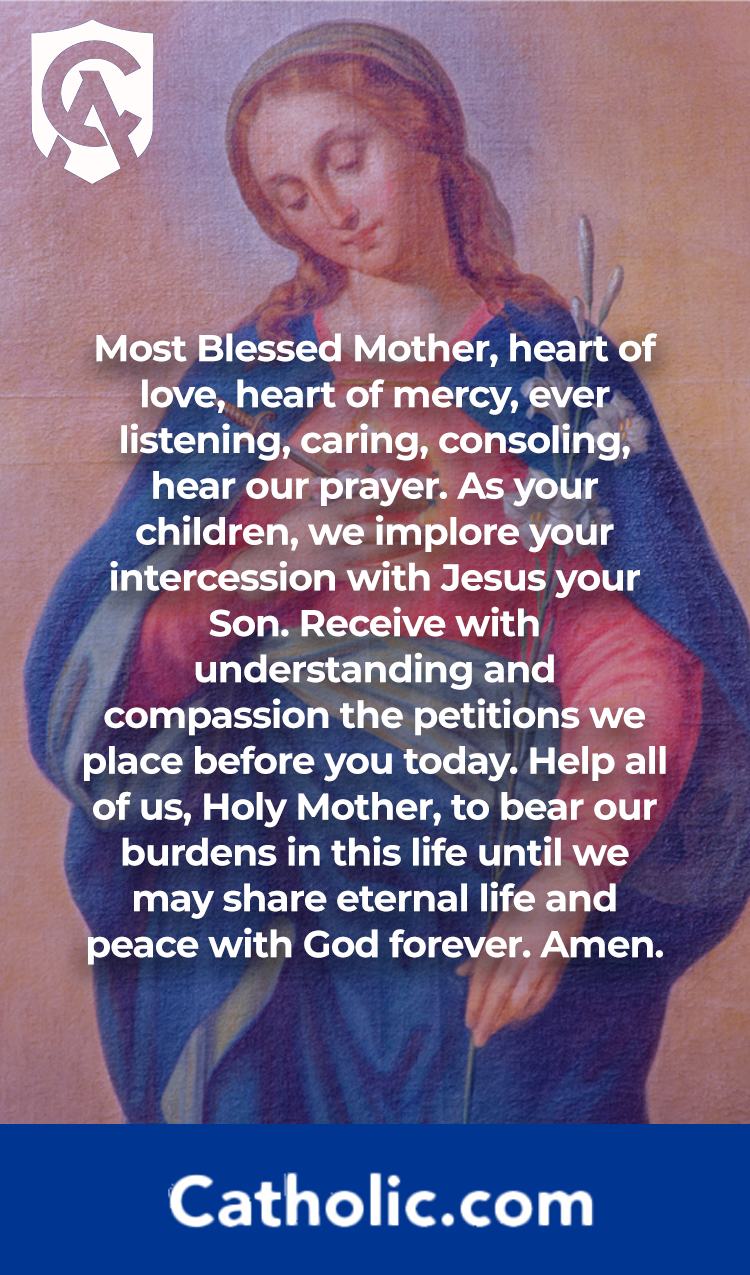
Free Download | Immaculate Heart Of Mary Prayer Card
Commonly Asked Questions
- What is the Immaculate Heart of Mary? The Immaculate Heart of Mary is a Catholic devotion honoring the Blessed Virgin Mary’s heart as a symbol of her holiness, her love for God in general and her divine Son Jesus in particular, as well as her maternal love for humanity.
- What does the Immaculate Heart of Mary symbolize? It symbolizes Mary’s interior life, particularly her love for God in general and her divine Son in particular, as well her virtues, joys. sorrows, and maternal compassion for us.
- Why is Mary’s heart called Immaculate? Mary’s heart is called immaculate because Mary was preserved by God’s grace from original sin at her conception, and because she remained free from personal sin with the Lord’s gracious help throughout her earthly life.
- When is the feast of the Immaculate Heart of Mary? The Immaculate Heart of Mary is celebrated on the Saturday following the Sacred Heart of Jesus. In 2026, it falls on June 13.
- What is the difference between the Immaculate Heart of Mary and the Sacred Heart of Jesus? The Sacred Heart represents the love of Jesus Christ, who is both true God and true man and so who is worshiped by Catholics and other Christians. The Immaculate Heart represents the love and holiness of Mary, a human creature whom Catholics honor but do not worship. Devotion to Mary’s Immaculate Heart does not terminate in the Blessed Mother, but rather is ordered toward deeper fellowship with her divine Son.
Related Content
Articles
Immaculate Conception and Assumption
Where Is the Immaculate Conception in the Bible?
Marian Dogmas | An Overview of the Four Marian Dogmas
The Sacred Heart of JesusCovenant
How Can You Say That Mary Is the ‘New Eve’?
Q&As
Why hasn’t the pope consecrated Russia to the Immaculate Heart?
First Saturday Devotion Requirements, Including Time Frame for Confession
Podcasts
What does one have to do to devote themselves to the Immaculate Heart of Mary?
DEBATE: Do the Marian Dogmas Contradict Scripture? (with Steve Christie)
Videos
Hard Truths About Marian Consecration
Why Do Catholics Have to Believe Mary Was Sinless and Assumed into Heaven?
Is There Biblical Support For The Immaculate Conception?
Books
Jesus and the Jewish Roots of Mary