



Excommunication in the Catholic Church
In the Catholic Church, excommunication is one of the most frequently misinterpreted disciplinary penalties. To many people, including many Catholics, the word excommunicated means the Church has abolished a person’s membership in the Church, perhaps even permanently and thus with irreversible afterlife consequences. In fact, while an excommunication is only given for certain grave wrongdoing, the censure does not abrogate a person’s membership in the Church, and it is a medicinal penalty given to help the offender repent and become reconciled back into full communion with our Lord Jesus Christ and his Church. Indeed, excommunication is meant to serve as a most serious spiritual reprimand, a wake-up call signaling to a Catholic he is in grave spiritual danger and that other Catholics should take heed to avoid such perilous conduct.
Why Does the Catholic Church Excommunicate?
Before discussing excommunications further, we need to first understand that the authority to issue this ecclesiastical penalty—and all others—is not based on a manmade tradition. Rather, it is grounded in the truth and teaching that Jesus founded his Church on St. Peter and the other apostles (Matt. 16:18-19; Eph. 2:19-22).
That is, Jesus founded a hierarchical Church, entrusting Peter and his papal successors with primacy of authority in leading the Church, and also—subordinately—the other apostles and their successors in serving under (and thus in communion with) St. Peter and subsequent popes.
Jesus institutes this visible leadership structure to attain and safeguard the unity among his disciples for which he prayed to his heavenly Father (John 17:20-23). And because Jesus is himself God, we know that his word is divinely guaranteed to come true (see Isa. 55:10-11).
As an expression of the authority to maintain unity and order within his Church, Jesus gave Peter and his fellow apostles the power to “bind and loose” (Matt. 16:19; 18:15-18), which includes censuring those who act in a manner gravely contrary to the Faith. A clear example is how St. Paul directs the excommunication of a man from full communion with his fellow Christians, given the man’s incestuous relationship with his stepmother:
[Y]ou are to deliver this man to Satan for the destruction of the flesh, that his spirit may be saved in the day of the Lord Jesus (1 Cor. 5:5).
By depriving this man of his greatest spiritual benefits—namely, the sacraments by which the faithful are protected from Satan and his demonic minions (see 2 Cor. 10:3-4)—the excommunication is ordered to help the man realize he is in lockstep with the devil who seeks his physical and spiritual demise; and the only way he can remedy the situation is to repent, so that he can receive anew the sacraments and other spiritual safeguards Jesus offers through his Church. In addition, barring someone from receiving the Eucharist who has committed mortal sin is a merciful protection by the Church, irrespective of whether his grave wrongdoing is an excommunicable offense (see 1 Cor. 11:27-29).
What Does Excommunicated Mean?
The word excommunicated comes from the Latin term meaning “put out of communion.” To be excommunicated means a person is cut off from full communion with Christ and his Catholic Church. An excommunication occurs because of some grave wrongdoing, which may be private or public. The censure does not invalidate a believer’s baptism, nor does it otherwise revoke his membership in the Church. The excommunicant’s continued membership is illustrated by his ongoing obligation to participate in weekly Sunday Mass, albeit in a restricted manner.
Still, an excommunication carries it with serious punitive effects, including barring a Catholic from receiving any of the sacraments until he has repented and had his excommunication lifted. For an excommunicated priest, he is effectively barred from exercising his priestly ministry, including celebrating the sacraments: the exception is that he can hear the confession of—and provide sacramental absolution to—a penitent in danger of death. (Here we observe that an excommunication is designed to punish justly the offending priest, not unjustly a person who may be in need of the priest’s God-given sacramental gifts.) In addition, as noted, an excommunication is ordered toward a Catholic’s reconciliation and repentance, not to permanently banish him. In this regard, the Church carries out the ministry of the Good Shepherd Jesus, who always seeks out a wayward sheep instead of waiting for that sheep to return home on his own (Luke 15:1-7). We’re also reminded that the only unforgivable sin is the one(s) for which we do not want forgiveness (CCC 1864).
What Is Excommunication in the Catholic Church? (Excommunication Definition)
Excommunication is a censure that is either imposed (de ferendae) or automatically incurred (latae sententiae) because of some grave wrongdoing. The Church employs excommunications to safeguard the sacraments, the Catholic faithful, and the Faith in general. The penalty is ordered toward helping sinners return to full communion with the Church and preemptively warn others away from serious sin and toward salvation. The Catechism of the Catholic Church (CCC) elaborates further:
Certain particularly grave sins incur excommunication, the most severe ecclesiastical penalty, which impedes the reception of the sacraments and the exercise of certain ecclesiastical acts, and for which absolution consequently cannot be granted, according to canon law, except by the Pope, the bishop of the place or priests authorized by them. In danger of death any priest, even if deprived of faculties for hearing confessions, can absolve from every sin and excommunication (CCC 1463, footnote omitted).
What Does It Mean to Be Excommunicated From the Catholic Church?
It is the most serious penalty in the canon law of the Church.
The Code of Canon Law lists the consequences of an excommunication:
Canon 1331— § 1. An excommunicated person is prohibited:
- 1° from celebrating the Sacrifice of the Eucharist and the other sacraments;
- 2° from receiving the sacraments;
- 3° from administering sacramentals and from celebrating the other ceremonies of liturgical worship;
- 4° from taking an active part in the celebrations listed above;
- 5° from exercising any ecclesiastical offices, duties, ministries or functions;
- 6° from performing acts of governance.
§ 2. If a ferendae sententiae excommunication has been imposed or a latae sententiae excommunication declared, the offender:
- 1° proposing to act in defiance of the provision of § 1 nn. 1-4 is to be removed, or else the liturgical action is to be suspended, unless there is a grave reason to the contrary;
- 2° invalidly exercises any acts of governance which, in accordance with § 1 n. 6, are unlawful;
- 3° is prohibited from benefiting from privileges already granted;
- 4° does not acquire any remuneration held in virtue of a merely ecclesiastical title;
- 5° is legally incapable of acquiring offices, duties, ministries, functions, rights, privileges or honorific titles.
The Church uses excommunication as a response when a person commits certain grave wrongdoing that is deemed especially heinous and/or very damaging to carrying out the mission of the Church. Excommunicable offenses include violating the seal of the confessional (canon 1386), desecrating the Holy Eucharist (canon 1382), and physically attacking the pope (canon 1370). In addition, as canon lawyer Pete Vere notes, “canon 1397 §2 imposes an automatic excommunication upon those who successfully procure an abortion, provided no diminishing causes are present.” Vere adds,
This should not surprise any Catholic: Abortion is one of the most serious offenses against human life. The act is intrinsically evil and the child in the womb is among the most defenseless of human life.
Canon law also provides various circumstances that can excuse or mitigate one’s culpability in incurring an excommunication (see canons 1321-1324). Bottom line, what is most important is not whether a person has been excommunicated, but whether he is in a state of grace. Indeed, excommunication exists not because the Church is harsh, but rather as a merciful reminder that there are sobering consequences to grave sin.
Does the Catholic Church Still Excommunicate People?
Yes, the Catholic Church still employs the censure of excommunication, as the foregoing citations from the current Code of Canon Law illustrate. It is an important ecclesiastical tool to help defend and advance the Church’s mission Excommunications are typically not publicly announced, unless there’s a related public scandal to remedy, as was the case when the Augustinian priest Martin Luther refused to repent of his heresies and submit to papal authority. Whenever possible, offenses are handled quietly through pastoral correction. The Church’s goal is to foster the reconciliation of transgressors, not engage in pointless public actions. Excommunication remains a real and important part of Catholic discipline, rooted again in the governing authority Jesus has given his Church.
How Do You Get Excommunicated From the Catholic Church?
Some people may ask this as a joke, but excommunication is serious business. Nobody is excommunicated for minor faults or everyday sins. Rather, excommunicable offenses are especially heinous crimes and/or ones very damaging to carrying out the mission of the Church. There are two ways in which excommunication occurs. In the case of a de ferendae excommunication, the Church imposes a penalty after conducting a canonical investigation into a person’s actions. Second, there are latae sententiae or automatic excommunications, in which a person incurs the penalty through committing the act itself. This is a shock to many people, but it demonstrates the importance of remaining in God’s grace, as well as the seriousness with which the Church treats certain offenses that harm souls and otherwise undermine the life of the Church.
Can Someone Who Is Excommunicated Rejoin the Catholic Church?
First, an excommunicant need not reestablish his membership as a Catholic, as if he’s completely lost it. Rather, he needs to be restored to full communion with Christ and his Church. In addition, a common fear is that excommunication is permanent. But the Catholic Church teaches the opposite. To reaffirm, the goal of an excommunication is to foster repentance, confession, healing, and thus full restoration of communion.
If you or someone you love is excommunicated, or you think you or they may be excommunicated, the Church does not want you to become discouraged, let alone despair. Rather, in concert with her Lord Jesus, the Church seeks your conversion and reconciliation. The first step is to speak with a priest to evaluate your situation, and, if needed, begin the path back to full communion, including receiving the sacrament of reconciliation. The door is not locked. God’s mercy is always greater than our sins.
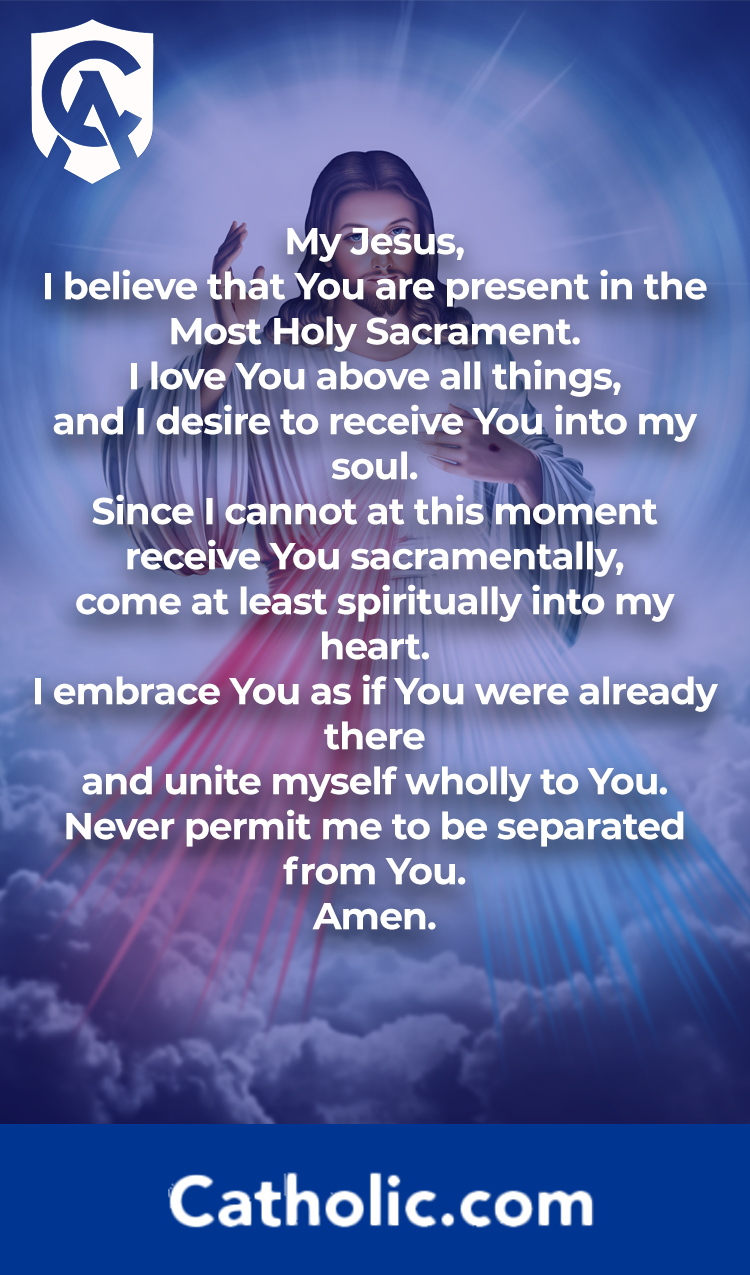
Free Download | Spiritual Communion Prayer Card
Commonly Asked Questions
- Can Catholics talk to someone who is excommunicated? Yes, Catholics may speak to an excommunicant and should always encourage him toward reconciliation.
- Is Catholic excommunication the same as Mormon excommunication? No. In contrast to the Mormon type, Catholic excommunication doesn’t abolish a person’s membership in the Church, although it does remove him from full communion with Christ and his Church—and thus participation in the sacraments.
- Was Martin Luther excommunicated? Yes. The Church excommunicated Martin Luther after he refused refusing to repent of his heresies and submit to Church authority on serious doctrinal issues.
- What happens if you die excommunicated? It’s possible, though highly unlikely, that a person could be excommunicated without being subjectively culpable of committing grave wrongdoing. In any event, excommunication itself is not a judgment that someone is eternally damned. However, if a person has committed grave wrongdoing and is subjectively culpable of a mortal sin, then he must repent and be reconciled with God to avoid hell. Only the Lord knows whether and how a sinner has repented who may have otherwise appeared to die in mortal sin. As a wise priest says, “Our job is sales; God’s is management.”
Related Content
Articles
Abortion, Excommunication, and Forgiveness: The Church’s Path to Healing
The Truth About Excommunication
Podcasts
Does Excommunication Condemn Someone to Hell?
Weird Bible Passage: Hand a Sinner’s Flesh to Satan?
Q&As
Why and How Is Someone Excommunicated?
Were the Divorced Excommunicated?
You’re Still a Catholic After Marriages and Divorces