



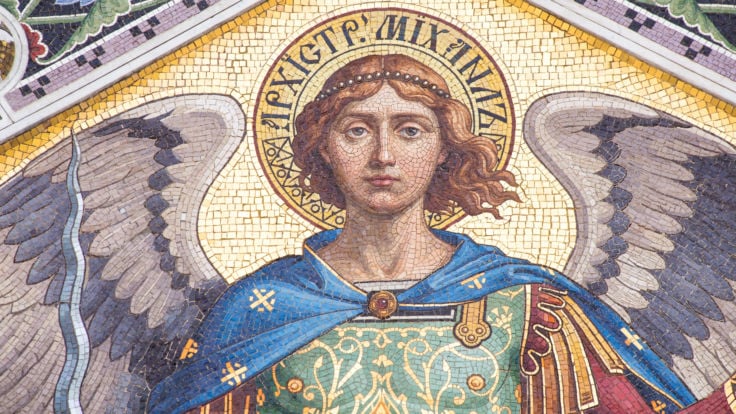
One day, after celebrating the holy sacrifice of the Mass during his pontificate, Pope Leo XIII had a terrifying vision in which Satan and his demonic minions sought to destroy our Lord Jesus Christ’s Catholic Church. In response, the pope issued his St. Michael the Archangel prayer, directing it to be said after Tridentine Low Masses in 1886.
Given the cultural erosion in America and around the world over the last several decades, many parishes—both here in the United States and elsewhere—have revived the practice of praying the St. Michael prayer after Mass. But this growing trend has sparked mixed reactions from the laity.
In a recent tweet, a young Jesuit, Joseph Nolla, affirmed the practice, stating, “Only good can come from this.” In response, he received strong pushback from Zac Davis, an associate editor of America, the Jesuits’ flagship publication in the United States. Davis, who is also senior director of digital strategy at America Media, tweeted,
I cannot express how much I dislike the St. Michael Prayer after Mass. It is so, so jarring to me every time. To say nothing of the intent/content of the prayer, the language, and repetition and prominence given to it breed a sense of paranoia and cynicism. Instead of going out to evangelize the world, everyone is ready to go to war with it. This prayer is totally fine in private devotion. It does not belong in the liturgy (or effectively within the liturgy, when it is said after the final blessing but before the recessional hymn) [emphasis added].
Davis’s tweet has received almost a million views, yet it promotes a significant error. In Leo XIII’s prayer, St. Michael is not invoked to wage war on the world, but rather to help us advance Christ’s kingdom on behalf of the world. Even the Church’s most ardent human enemies are mercifully included in the Church’s God-ordained mission to “make disciples of all nations” (Matt. 28:18-20; see 1 Pet. 3:15).
Rather, Pope Leo understood well that the devil and his demonic minions are the true and incontrovertible enemies of Christ, his Church, and the world Jesus came to save through his Church (John 3:16-17; Matt. 16:18-19). St. Paul affirms the same in his Letter to the Ephesians: “For we are not contending against flesh and blood, but against the principalities, against the powers, against the world rulers of this present darkness, against the spiritual hosts of wickedness in the heavenly places” (Eph. 6:12).
Asking for the intercession of St. Michael, who led the fight in casting out from heaven the rebellious Satan and his infernal underlings, is an important way we can wage battle on behalf of the world (see Rev. 12:7-12).
In addition, the prayer doesn’t breed paranoia of evil spirits—or, at the very least, shouldn’t. Satan and his demonic subjects operate in this world whether we acknowledge them or not, and pooh-poohing their existence only thwarts the Church’s mission. Indeed, concerns about cynicism notwithstanding, our life in Christ is unmistakably a spiritual battle in which we cannot be bystanders (see 2 Cor. 10:3-4; Eph. 6:10-18; 1 Tim. 6:11-12)
At the same time, we are “more than conquerors” in Christ (Rm. 8:37-39), because evil spirits are subject to their Creator. Still, the devil will wage war until our Lord’s Second Coming and Final Judgment (see Rev. 20:2-3; see CCC 394-395; 407; 414). And thus the Church on earth remains the Church Militant, invoking our Lord Jesus, St. Michael, the Blessed Mother, and other heavenly luminaries to aid us in our cause (see Jas. 4:7).
Overcoming Embarrassment about Belief in the Devil and Other Demons
The recitation of the St. Michael prayer may tempt us to embarrassment in reaching out to an increasingly disbelieving world, but a quick reexamination of the Gospels reminds us that Jesus—the first and prototypical exorcist—wasn’t shadowboxing phantom spirits. Instead, he faced the devil directly, including in the desert at the beginning of his earthly ministry and also later in the Garden of Gethsemane and on the Cross. He knew he had come to overcome sin, death, and the devil (see John 12:31-33).
Thus, the St. Michael prayer is not antiquated piety, but a reminder of sober truth, and thinking otherwise won’t change that “your adversary the devil prowls around like a roaring lion, seeking some one to devour” (1 Pet. 5:8).
That’s all part of the Gospel message, and Leo XIII knew it, as did John Paul II. While never formally reinstituting the St. Michael prayer after Mass, John Paul II strongly encouraged the faithful to pray it, and he also permitted its renewed recitation after Mass as a legitimate custom: “Although this prayer is no longer recited at the end of the Eucharistic celebration, I invite everyone not to forget it, but to recite it to obtain help in the battle against the forces of darkness and against the spirit of this world” (no. 4).
The resurgence of the prayer’s recitation after Mass continued under Pope Benedict XVI and also Pope Francis, who spoke often of the devil and encouraged the prayer’s recitation in general. Nor has Pope Leo XIV—who has recognized and encouraged the ministry of exorcists—reined in the practice.
Although there are many benefits to reciting the St. Michael prayer, our fight against the devil should not consist solely in this, but also in frequent and reverent reception of the Eucharist, going regularly to confession (which the devil hates, realizing the sacrament’s great power), as well as participating in Eucharistic adoration (whether reserved or exposed), so that we can draw closer to our Lord and remain in intimate communion with him and one another.