



Who Is St. Christopher?
According to ancient Christian tradition, St. Christopher was a martyr who lived during the early centuries of the Church. While we know with certainty few details about his life, devotion to St. Christopher spread rapidly throughout early Christendom because of the powerful witness associated with his story.
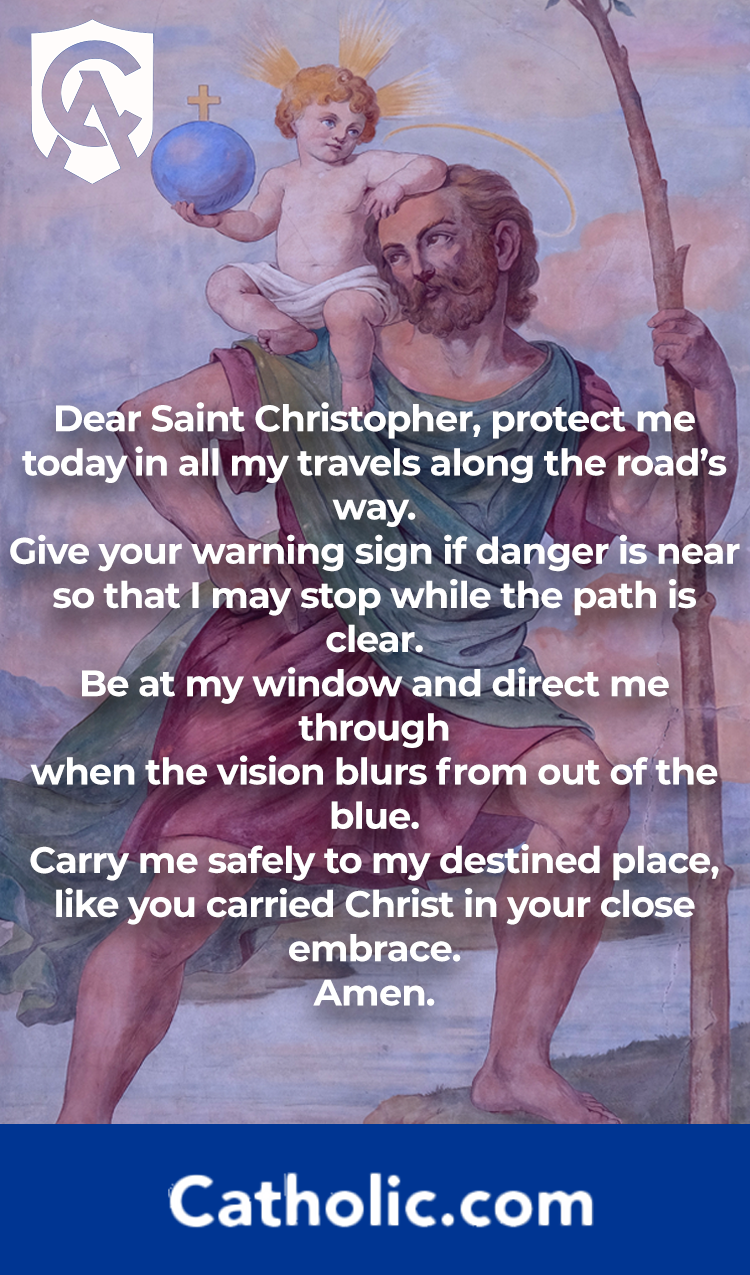
Longstanding tradition records that Christopher sought to serve the greatest king in the world. After learning that Jesus Christ is the King of kings (Rev. 17:14), Christopher received baptism and dedicated his life to serving the Lord (see Acts 2:37-39). In the classic account of his life, Christopher devoted himself as a young Christian to carrying travelers across a dangerous river. One day, he encountered a child whose weight seemed to increase with every step, and Christopher almost drowned in navigating the river with the boy on his shoulders. The Child then revealed himself to be none other than Jesus.
This story winsomely illustrates the Christian call to carry Christ—i.e., to bear witness to him—to everyone we encounter on a daily basis. Indeed, the saint’s name—Greek: Christos (Christ) pherein (to bear); Latin: Christo-phorus (Christ-bearer)—attests that Christopher faithfully bore witness to the Savior whom we loved. Given his steadfast faith, which bore fruit through the conversion of many others, Christopher endured martyrdom, reportedly under a Roman emperor in the 250s.
For those who doubt St. Christopher’s historicity, a church built in the early 450s in Bithynia (modern-day Turkey near Chalcedon) provides testimony to the contrary, as does other ecclesiastical evidence from the 500s and early 600s.
St. Christopher’s feast day is celebrated on July 25.
What Is St. Christopher the Patron Saint of?
Many people wonder, what is St. Christopher the patron saint of? St. Christopher is traditionally honored as the patron saint of travelers, motorists, sailors, pilgrims, and those who journey far from home.
In his great medieval compendium on the saints (The Golden Legend), Jacobus de Voragine describes how Christopher earned his saintly patronage in safely crossing a river with a mysterious child:
Setting the child down he said to him, “My boy, you put me in great danger, and you weighed so much that if I had the whole world on my back I could not have felt a heavier burden!” The Child answered him, “Don’t be surprised Christopher! You were not only carrying the whole world, you had him who created the world on your shoulders! I am Christ your King, to whom you render service by doing the work you do here. And if you want proof that what I am saying is true, when you get back to your little house, plant you staff in the earth, and tomorrow you will find it in leaf and bearing fruit!” With that the Child vanished. Christopher crossed over and thrust his staff into the earth near his shelter. The next morning he rose and found the staff bearing leaves and fruit like a palm tree.
Because of his association with safely carrying travelers across a river, Catholics have long sought St. Christopher’s intercession before embarking on trips. His example reminds us that every journey, whether across town or anywhere in the world, should be a journey with—and as an ambassador for—Jesus Christ (see 2 Cor. 5:18-20). So Christians ask for the saint’s prayers not because Christopher possesses power apart from God, but rather because he, like all saints, intercedes for us in heavenly communion with the Lord (see Rev. 5:8; Heb. 12:23).
The Witness and Martyrdom of St. Christopher
Like many saints of the early Church, St. Christopher is remembered for his faithfulness to Christ unto death. Christian tradition holds that he suffered martyrdom during a period of Roman persecution. An edifying story associated with Christopher’s death reminds us to pray for our persecutors, that they may ultimately join us in joyous communion in heaven, a standard of love which we cannot attain apart from Jesus (see Matt. 5:43-48). Christopher told a king in Lycia (present-day Turkey) to take the blood from Christopher’s martyrdom and rub it in his (the emperor’s) blinded eyes. After executing the saint, the emperor followed Christopher’s directive, was immediately cured, and promptly converted to the Faith.
The Church has always honored martyrs because they demonstrate the ultimate form of discipleship: remaining faithful to Jesus even at great personal cost (see John 13:34; 15:13). The enduring popularity of St. Christopher reflects the admiration Christians have for those who place their trust in God above all earthly concerns.
Misconceptions about the St. Christopher Medal
Some mistakenly believe a St. Christopher medal functions as a good-luck charm or magical object. This is not what the Catholic Church teaches. Catholics do not idolatrously place their trust in medals, or other objects associated with Christian devotion (see CCC 2115-2117). Rather, sacramentals point believers toward Christ and encourage prayer rooted in the Lord Jesus.
Another common misunderstanding concerns the historical existence of St. Christopher. Because many details of his life are based more on traditions than historically verified fact, and because the Church removed Christopher’s feast from the Church’s universal calendar, many ask, is St. Christopher still a saint?
The answer is yes. In 1969, the Church revised the General Roman Calendar, including through removing saints whose devotion was not as universal, as well as to accommodate the martyrs of countries who had, in more centuries, accepted the gospel. However, St. Christopher was never “de-canonized,” nor did the Church declare him a myth. He remains a saint who may be venerated by Catholics throughout the world. As Pope Paul VI decreed in his motu propio Mysterii Paschalis,
It cannot be denied, however, that in the course of centuries the feasts of the saints have become more and more numerous. . . .
In order to execute this decision of the Ecumenical Council [Vatican II], the names of some saints have been removed from the universal Calendar, and the faculty has been given of re-establishing in regions concerned, if it is desired, the commemorations and cult of other saints. The suppression of reference to a certain number of saints who are not universally known has permitted the insertion, within the Roman Calendar, of names of some martyrs of regions where the proclaiming of the Gospel arrived at a later date. Thus, as representatives of their countries, those who have won renown by the shedding of their blood for Christ or by their outstanding virtues enjoy the same dignity in this same catalogue.
For these reasons we think that the new universal Calendar, prepared for the Latin rite, is more in harmony with the piety and the needs of our times, and that it better reflects the universality of the Church, in the sense that it proposes the names of the most important saints, who present to all the People of God a shining example of sanctity in a variety of ways (no. II).
Why Catholics Wear a St. Christopher Medal
One of the most recognizable Catholic sacramentals is the St. Christopher medal, which depicts the Child Jesus on the saint’s shoulders as he crosses a river. Many Catholics wear a related St. Christopher necklace or St. Christopher pendant as an outward sign of faith.
Sacramentals are sacred signs the Church authorizes to help dispose us to receive God’s grace. In wearing a St. Christopher medal, we daily remind ourselves—and others—to pray to and trust in Jesus, including by interceding with Christ’s heavenly collaborators, the saints. For Christian travelers, donning a St. Christopher medal visibly reminds them that the Lord Jesus accompanies them wherever they go.
A St. Christopher necklace, which features the saint’s devotional medal, can be given as a gift before one embarks upon military service, college, missionary work, or some other major life journey, and the gift can be self-bestowed as well. The same applies for going on a vacation. The practice reflects a desire to keep Christ at the center of every path we take, and to bear witness to him along the way (see 1 Pet. 3:15).
What Does St. Christopher Represent?
At its heart, the story of St. Christopher symbolizes carrying Christ to the world: i.e., as his name conveys, to bear witness to Jesus in thought, word, and deed to everyone we encounter (see Col. 3:15-17)
The saint’s example teaches Christians to serve others with humility, bear life’s burdens with faith, and trust God even when the road ahead seems uncertain, and even impossible to navigate. Just as Christopher carried Christ across the river faithfully, so Catholics are called to carry Christ into their daily encounters with their families, co-workers, and in their larger communities.
Devotion to St. Christopher Today
Devotion to St. Christopher remains widespread throughout the Catholic world. Many parishes named St. Christopher Church or St. Christopher Catholic Church continue to honor the saint and his legacy. His name can also be found in institutions such as St. Christopher’s Hospital, St. Christopher Hospital, and St. Christopher’s Children’s Hospital, which reflect the enduring impact his service and protection—including for those who have invoked his intercession over the centuries .
Though many, many years have passed since his martyrdom, Christians continue to look to St. Christopher as a model of faith, courage, and so they trust in God’s providence by invoking the saint’s intercession.
Common Questions (CAQ)
- What does St. Christopher represent? He represents faithful service to Christ and trust in God during life’s journeys.
- What does St. Christopher symbolize? He symbolizes carrying Christ in our hearts and helping others to draw closer to the Lord.
- What is St. Christopher saint of? He is traditionally the patron saint of travelers, including in severe weather, and of those who embark on major life journeys.
- Is St. Christopher still a saint? Yes. The Catholic Church continues to recognize and venerate St. Christopher as a saint, including permitting priests to offer Masses in his honor on his feast day (July 25).
- Where is St. Christopher and Nevis? This refers to a dual-island Caribbean nation, more commonly known known as Saint Kitts and Nevis. Its larger island was historically called Saint Christopher.
Free Download | St. Christopher Prayer Card
Related Content
Articles
St. Christopher How to Explain Sacramentals to Fundamentalists, Part I
How to Explain Sacramentals to Fundamentalists, Part II
Podcasts
Q&As
Is St. Christopher Still a Saint?
Did the Church Declare that St. Christopher Is a Myth?
Why is St Christopher Shown with a Dog’s Head?
Avoid Superstition Regarding Sacramentals