



Who Was Saint Joseph?
Saint Joseph is one of the most beloved saints in the Catholic Church, given his roles as both the guardian of the Holy Family and also Patron of the Universal Church. As the husband of the Blessed Mother and foster father of our Lord Jesus Christ, he shines as a model of quiet servant leadership.
Although Scripture records none of his words, we know that St. Joseph exemplified faith, trust, and courage, including in leading Mary and Jesus away from Herod’s homicidal rage in Bethlehem, and then in returning from Egypt to the Holy Land (Matt. 2:13-23).
In addition, St. Joseph inspires laborers the world over for his commitment to excellence as a carpenter in providing for his family.
What Is Saint Joseph Known For?
As the husband of Mary and foster father of Jesus, St. Joseph is known—above all—for his faithful guardianship of the Holy Family, protecting his wife and Son amidst Herod’s attempt to kill the Messiah in Bethlehem, and then providing for them as the Lord grew up in Nazareth. Joseph’s life shows how we can grow in holiness through a quiet commitment to our daily responsibilities and thus without the fanfare of public recognition.
Catholics also honor St Joseph as a model for all laborers. He was a carpenter (Greek: tekton), and therefore a craftsman who excelled in working with wood, stone, and metal. In using his God-given skills to provide for his family, Joseph sanctified his everyday labor, which is why the Church celebrates St. Joseph the Worker (feast day, May 1) as a model for laborers everywhere. In addition, Joseph is known for his purity as the Blessed Virgin Mary’s husband. One tradition presents Joseph as an older widower with children when he married Mary, while another portrays him as a young man who had never married before. In any event, we hail St. Joseph for his exceptional marital chastity. He and Mary had a valid marriage and yet chose not to consummate their union, according to God’s plan for their lives. Thus the term “Josephite marriage” and his serving as Mary’s “Most Chaste Spouse,” as we proclaim in the Divine Praises.
What Is St Joseph the Patron Saint of?
Many Catholics ask: what is St. Joseph the patron saint of? Over centuries of devotion, the Church has recognized Joseph as the patron saint of fathers, families, workers, and a happy death. Because he cared for Jesus and Mary with fatherly devotion, he is especially honored as the protector of families and homes.
In 1870, Pope Pius IX proclaimed Joseph as the Patron of the Universal Church, a title which reflects that just as Joseph protected the Holy Family, he now watches over the entire Church. Consequently, many Catholics offer a St. Joseph prayer, a prayer for protection, or the Litany of Saint Joseph, e.g., when asking for guidance, spiritual strength, or support at work and/or in family life. As the Litany of St. Joseph provides, his titles include “Terror of Demons,” reminding the faithful he is a safe refuge in Christ in their time of trial.
When Is Saint Joseph’s feast day?
The principal feast day of Saint Joseph is March 19, which honors him as the Spouse of the Blessed Virgin Mary. Because it’s a solemnity, it also typically provides a respite from Lenten penances, including abstaining from eating meat if it falls on a Lenten Friday. If March 19 falls on a Lenten Sunday, it is transferred to the ensuing Monday, March 20. In the rare case when March 19 falls during Holy Week, it is transferred to an earlier date, typically the Saturday before Palm Sunday. In many cultures—especially among Italian and Italian-American Catholics—this day includes special meals, prayers, and acts of charity in honor of the saint who protected the Holy Family and continues to protect Christ’s Church.
The Church also celebrates Saint Joseph the Worker on May 1, which highlights Joseph as a model laborer in carrying out the dignity of work: i.e., as a basic, God-given vocation in which we fulfill ourselves through participating in God’s creation and contributing to the common good. Pope XII established this feast in 1955 to promote the Church as the true defender of the working man, and to counter International Workers Day—also known as May Day—which atheistic communist regimes like China still commemorate. Consequently, on May 1, the Church reminds the faithful that everyday work can become a path to holiness when done with love and dedication to God. Finally, the Church honors St. Joseph as a member of the Holy Family, a feast which is celebrated on the Sunday between Christmas and New Year’s Day, except when those two feasts fall on successive Sundays—in which case the Feast of Holy Family is moved to December 30.
Why Do Catholics Pray to Saint Joseph?
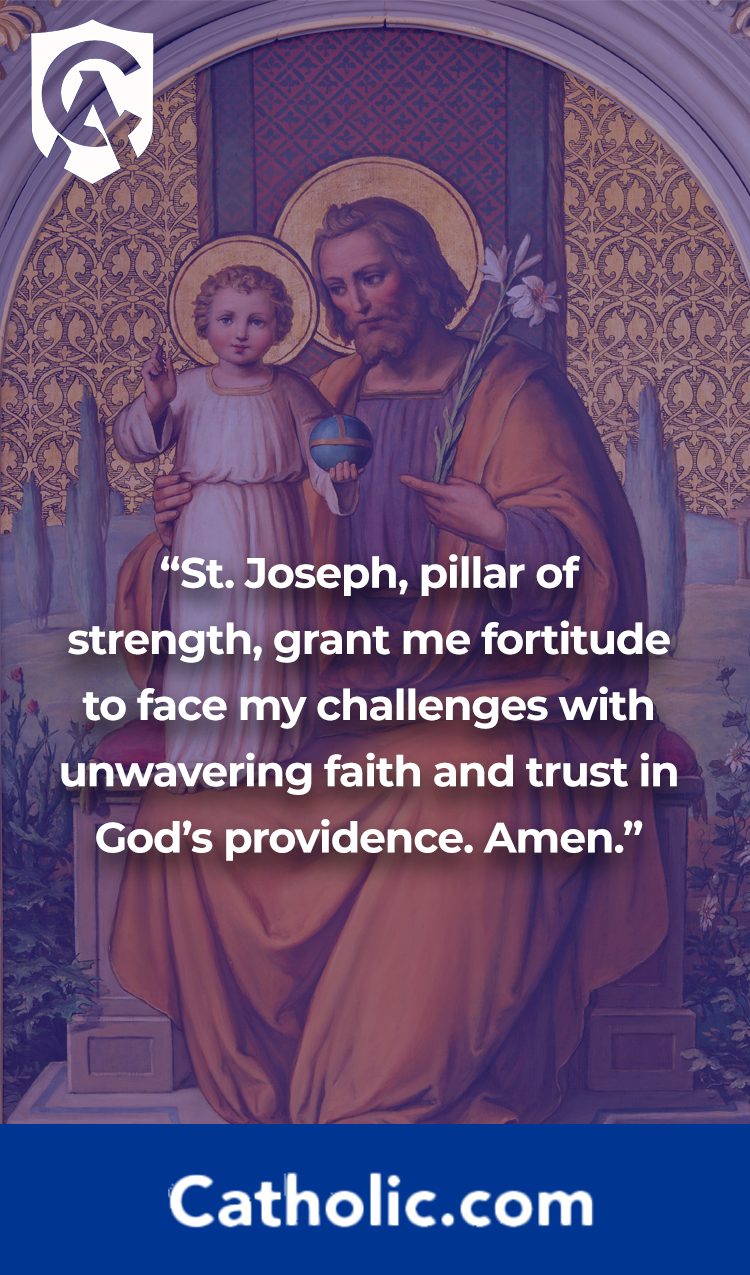
The saints in heaven intercede for us, their brothers and sisters, here on earth. Because of Joseph’s unique role in caring for Mary and Jesus, devotion to St. Joseph has grown throughout Christian history. Many Christians pray the St. Joseph novena, the Litany of St. Joseph, or a simple prayer to St. Joseph, asking for Joseph’s guidance, protection of their families, and/or help in difficult circumstances.
Devotion to St. Joseph is especially strong among fathers and workers, who see in him a model of responsibility, fidelity, and quiet courage. The Church also encourages prayers to St. Joseph for a happy death, since tradition holds that he died serenely in the presence of Jesus and Mary. For this reason, Catholics trust his intercession when asking for peace at the end of life.
How Did St. Joseph Die?
The Bible does not record when or how St. Joseph died. However, Christian tradition holds that Joseph died before Jesus began his public ministry. This explains why he does not appear in later events of the Gospels, including our Lord’s crucifixion.
Church tradition describes Joseph’s death as a peaceful one, surrounded by Jesus and Mary. Because of this longstanding tradition, he is honored as the patron saint of a happy death. Catholics often pray to St. Joseph that they and their loved ones may also pass from this life in God’s friendship, supported by the prayers of Christ’s Church.
Why Is devotion to St Joseph Important Today?
Devotion to St. Joseph continues to grow around the world because his life speaks directly to the challenges of modern families, particularly to fathers who lead those families. In a culture that often overlooks humility and quiet service, Joseph stands as a reminder that holiness is found in faithfulness to God’s will.
The Church also encourages special devotion during the month of St. Joseph, which is traditionally observed in March. During this month many Catholics pray the St. Joseph prayer, meditate on his role as the head of the Holy Family in praying a novena to St. Joseph, ask for his help at work or home, and/or intercede for his spiritual protection in general.
Through his example of trust, sacrifice, and love, St. Joseph continues to guide believers closer to our Lord Jesus in living the life of grace.
Free Download | St. Joseph Prayer Card
Commonly Asked Questions
- Why do people bury St Joseph statues at their homes? This is a misguided tradition in which some have buried a statue of St. Joseph (49:30ff.) on their property, while praying for his intercession to help sell a home. This is a superstitious practice (CCC 2111) that the Church has never sanctioned. However, the Church always recommends praying to St. Joseph as the patron saint of families.
- Was St. Joseph married before Mary? Did St. Joseph have other children? There is an ancient tradition that Joseph was an older widower who had children from a previous marriage. However, this is simply that: a tradition. He could’ve been a young, unmarried man when he married Mary. In addition, the Church dogmatically teaches Mary’s perpetual virginity (CCC 499), meaning that she and St. Joseph had a valid, but unconsummated marriage .
- Did St. Joseph sin? There is no definitive Church teaching on this matter. Scripture describes St. Joseph as a “just man” (Matt. 1:19), and the Church otherwise testifies to his holiness. There is a tradition that, as with St. John the Baptist, St. Joseph was sanctified in the womb and thus avoided personal sin in his life, but this is not an official Church teaching.
- Where was St. Joseph born? The Bible does not record the birthplace of St Joseph, although he was from the royal line of King David and later lived in Nazareth in Galilee. Because of his Davidic lineage, which means he descended from the tribe of Judah, some traditions report Bethlehem as his place of origin (see 1 Chron. 2:50-54; Mic. 5:2)
- What and when is St Joseph’s feast day? The primary feast day of Saint Joseph, which honors him as the Spouse of the Blessed Mother, is celebrated on March 19. The Church also honors St. Joseph as Saint Joseph the Worker on May 1, highlighting his example of faithful labor.
Related Content
Articles
Podcasts
Did Mary and Joseph Vow to Live Chastely in Their Marriage?
What Modern People Can Learn from St. Joseph
Q&As
Why Are SS. Joseph and Dymphna Both on My Medal?
Shop
Consecration to St. Joseph: The Wonders of Our Spiritual Father
To Know St Joseph: What Catholic Tradition Teaches About the Man Who Raised God