



What Are Guardian Angels?
God created guardian angels as spiritual beings, and he has assigned many of them to guard and guide his human disciples. Rooted in Sacred Scripture, the Catholic Church teaches that angels are spiritual creatures with intellect and will, and that guardian angels have a special divine mission.
The Catechism of the Catholic Church (CCC) adds, “From its beginning to death, human life is surrounded by their watchful care and intercession. . . . Already here on earth the Christian life shares by faith in the blessed company of angels and men united in God” (CCC 336). Belief in guardian angels is definitively taught by the Church.
The Feast of the Guardian Angels is celebrated every year on October 2.
Are Guardian Angels Biblical?
Guardian angels appear in various parts of Scripture, such as in the Old Testament:
For he will give his angels charge of you to guard you in all your ways.
On their hands they will bear you up, lest you dash your foot against a stone (Ps. 91:11-12).
In the New Testament, Hebrews 1:14 also teaches that theses angels are “ministering spirits sent forth to serve, for the sake of those who are to obtain salvation.”
Jesus teaches on guardian angels in Matthew 18:10, providing a warning for those who would lead children astray: “See that you do not despise one of these little ones; for I tell you that in heaven their angels always behold the face of my Father who is in heaven.” This passage shows both their closeness to God and their care for human souls.
Why Do Catholics Pray to Their Guardian Angel?
Catholics do not worship angels. Worship belongs to God alone. When we pray to our guardian angel, we ask for their intercession, just as we ask the saints to pray for us, as well as our friends of ours here on earth. If the prayer of a righteous man in this world “has great power in its effects” (Jas. 5:16), how much more the saints, i.e., “the spirits of just men made perfect” in heaven (Heb. 12:23), as well as our guardian angels, whom Jesus teaches “always behold the face of my Father who is in heaven”? (Matt. 18:10).
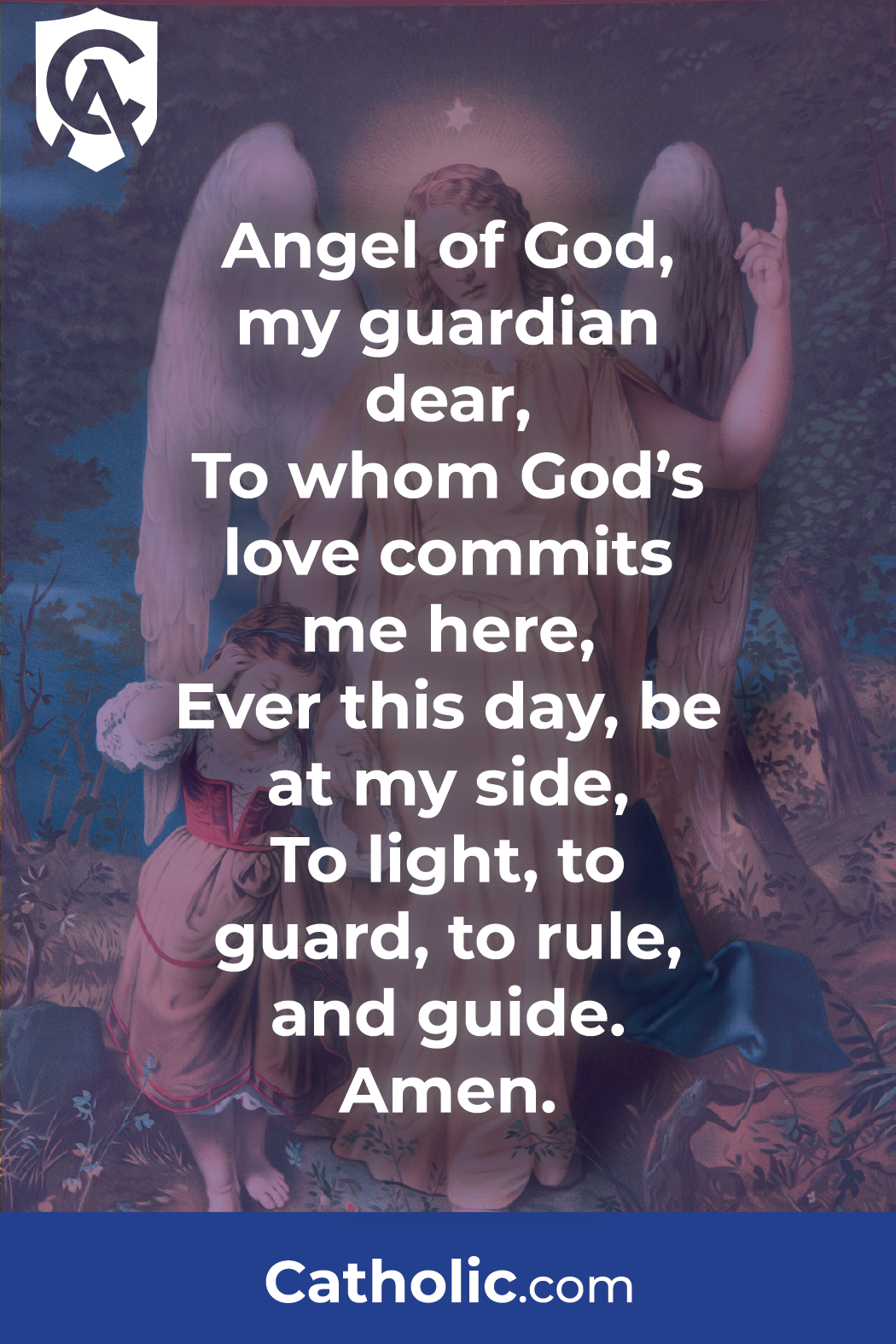
The prayer to your guardian angel reflects the Church’s teaching—guardian angels guard us, protect our souls, and guide us on God’s path:
Angel of God, my guardian dear,
To whom God’s love commits me here,
Ever this day, be at my side,
To light, to guard, to rule, and guide.
Amen
Free Download | Guardian Angel Prayer Card (English)
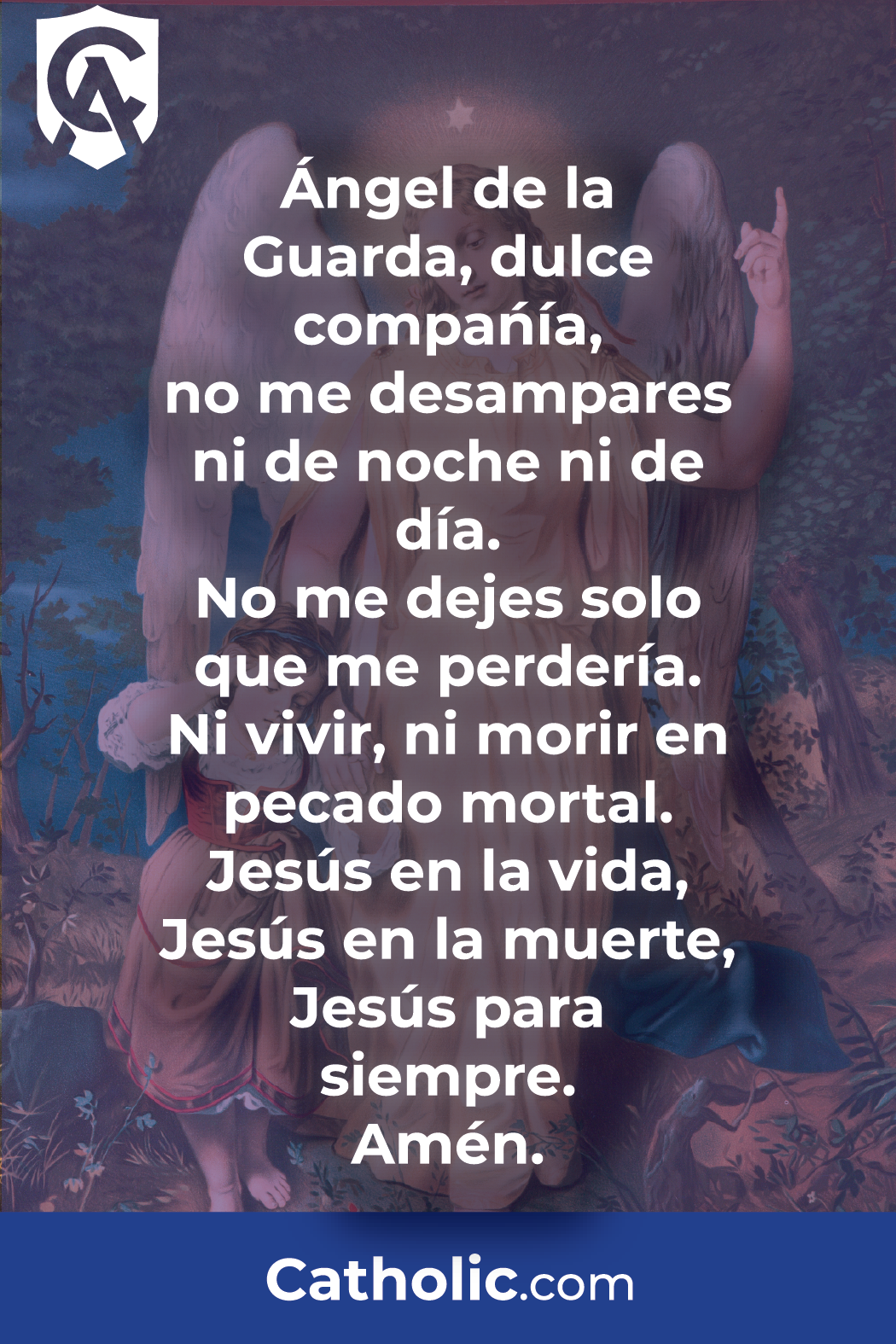
Free Download | Oración al Ángel de la Guardia (Spanish)
Does Everyone Have a Guardian Angel?
The Church definitively teaches that every baptized human person has a guardian angel. In addition, it is a common teaching of the Church that every human person has a guardian angel. As St. Jerome provides in teaching on Matthew 18:10, “How great is the value of the (human) soul that every single person has from birth received an angel for his protection” (Commentary on the Gospel of Matthew 18, bk. 2). St. Thomas Aquinas, among others, concurs (Summa Theologiae, I, q. 113 a. 2, resp.) Guardian angels are assigned by God, not chosen by us. In any event, God certainly cares for each of us from the moment of our conception.
Our guardian angel’s role is to help lead us toward salvation. They act as a rule and guide, always respecting our free will. They cannot force us to do good, and they cannot override our choices, yet they are always there to support us if we remain docile to them in the Lord.
What Do Guardian Angels Do, and Not Do?
Guardian angels protect us from spiritual harm, guide our conscience, and intercede for us in prayer. They can inspire good thoughts in us and warn us away from danger, including regarding demons (fallen angels), who are active in the world of the occult (see CCC 2116-2117). But they do not replace God, grace, or human responsibility. Rather, they work in faithful concert with God and man. Unlike Mormonism or Islam, the Catholic Church teaches that public revelation came to an end with God’s definitive Word to mankind—Jesus Christ—and with the New Testament. Because of this, when angels appear to humans, the message they send must always fall in line with what has already been revealed to us through public revelation.
Similar to our Lord Jesus, our guardian angels are not our celestial bellhops or a spiritual vending machine. Thus, they do not:
- Reveal secret knowledge on demand;
- Deliver personal prophecies upon our request;
- Bypass God’s authority.
In addition, any claim of “7 signs your guardian angel is trying to contact you” should be dismissed. The Church warns against superstition and New Age practices that treat angels as tools or energies rather than servants of God. The best way to stay close to your guardian angel is through a strong interior life, which is best supported by daily prayer, frequent reception of the Holy Eucharist, and regular reception of the sacrament of confession. In doing so, we will be well-attuned to hear God’s still, small voice, and that of our guardian angel—and, as well, the angels and saints in heaven in general (see 1 Kings 19:11-13; Rom. 8:28).
Can I Know My Guardian Angel’s Name?
The Church teaches that we should not seek to name our guardian angel, because naming implies authority over another, and that’s God’s purview, not ours. Nor should we attempt to discover our angel’s name, which could unwittingly open us up to evil spirits, who might try to impersonate our guardian angels.
Naming angels is restricted to God, so we should not ascribe names to any beyond those whose name the Lord has revealed in Scripture: Gabriel, Michael, and Raphael. In each case, God authorized these angels to reveal their names, but the humans they visited did not ask for them. In fact, when individuals asked for the name of an angel in Scripture, the angel reproved them (Gen 32:24-29, Judg. 13:18).
In the Directory on Popular Piety and the Liturgy, the Church counsels us to avoid other expressions of misguided devotion regarding our guardian angel, including:
when the daily events of life, which have nothing or little to do with our progressive maturing on the journey towards Christ are read schematically or simplistically, indeed childishly, so as to ascribe all setbacks to the Devil and all success to the Guardian Angels.
Guardian Angels and the Catholic Church
The Catholic Church’s belief in guardian angels is not folklore or sentiment. It is grounded in Scripture, and definitively affirmed by the Church’s Magisterium (see CCC 85-87).
Guardian angels remind us that God is close, personal, and active in our lives. They exist to always point us to the Father who is in heaven. It is good for the faithful to cultivate relationships with the angels and saints in heaven, especially with our guardian angels, who, though not visible, exist to support us in this life and ultimately guide us to heaven.
Related Content
Articles
Revelation: Public and Private
Q & As
Did Jesus have a guardian angel?
Podcasts
Do Guardian Angels Influence Non-Believers?
What Do Catholics Believe About Guardian Angels?
Shop
20 Answers: Apparitions & Revelations