


Question:
Answer:
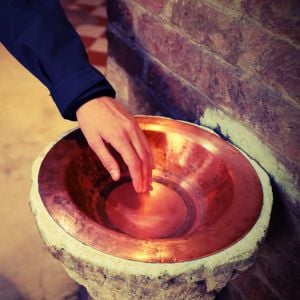
Emptying or covering holy water fonts during Lent is a modern innovation not found in the Church’s directives. Water is always kept in the holy water fonts until after Mass on Holy Thursday, when they are emptied of holy water and later refilled with the water blessed at the Easter Vigil (Congregation for Divine Worship (CDW), Paschalis Solemnitatis 97).
Lent is a time when we need the spiritual benefits of holy water. Holy water is a protection from evil, a reminder of our baptism and of our commitment to live a Christ-centered life. Empty holy water fonts during Lent only deprive the faithful of spiritual benefits that are theirs by right.
In response to a dubium on this subject (Prot. N. 569/00/L), the CDW in 2000 stated,
This Dicastery is able to respond that the removing of Holy Water from the fonts during the season of Lent is not permitted, in particular, for two reasons:
1. The liturgical legislation in force does not foresee this innovation [i.e., removing holy water during Lent], which in addition to being praeter legem [i.e., outside of the law] is contrary to a balanced understanding of the season of Lent, which though truly being a season of penance, is also a season rich in the symbolism of water and baptism, constantly evoked in liturgical texts.
2. The encouragement of the Church that the faithful avail themselves frequently of her sacraments and sacramentals is to be understood to apply also to the season of Lent. The “fast” and “abstinence” which the faithful embrace in this season does not extend to abstaining from the sacraments or sacramentals of the Church. The practice of the Church has been to empty the Holy Water fonts on the days of the Sacred Triduum in preparation of the blessing of the water at the Easter Vigil, and it corresponds to those days on which the Eucharist is not celebrated (i.e., Good Friday and Holy Saturday).
This also means that replacing holy water with sand during Lent is likewise prohibited, despite an unauthorized practice from recent decades in which some liturgists have sought to heighten awareness of the “desert experience” of Lent through this innovation.
Regarding your other question, the General Instruction on the Roman Missal (GIRM) requires a crucifix to be present during the celebration of the Mass. It may be possible to get away with replacing the main sanctuary crucifix with a cross if there is another crucifix present at least during the Mass (e.g., if an altar server or crucifer bears a crucifix into the sanctuary during the entrance). The covering of crosses is permitted during the last two weeks of Lent (approved by USCCB and Holy See, effective April 2002). In the Roman Missal itself, the rubrics for the Fifth Sunday of Lent state:
In the Dioceses of the United States, the practice of covering crosses and images throughout the church from this Sunday may be observed. Crosses remain covered until the end of the celebration of the Lord’s Passion on Good Friday, but images remain covered until the beginning of the Easter Vigil.