



As a Catholic woman, I have been bombarded with discussions about modesty my entire life, even more so in the past few years as many young adults have returned to tradition. And while I’m pleased to see so many young women trying to dress more modestly, I’m concerned that their understanding of modesty is totally backwards.
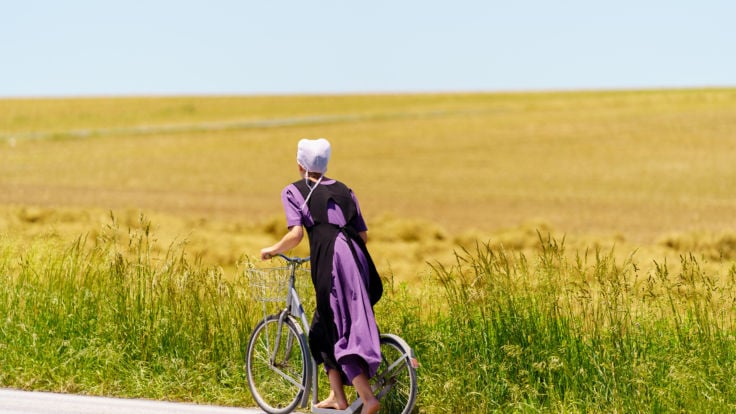
Of course, you have the group of women online who truly believe they’re dressing modestly and proceed to flaunt their bodies on camera in crop tops, low-cut dresses, and even sheer clothing. On the other hand, you have young women posting outfits that appear to belong to a twentieth-century FLDS woman. These women go to gyms wearing tea-length athletic skirts, long-sleeved shirts, and sometimes even head coverings. Even though this preferred dressing style may feel like a genuine conviction of the heart, it still reads as attention-seeking behavior.
Let’s unpack what modesty really is. The Catechism of the Catholic Church states:
Modesty protects the mystery of persons and their love. It encourages patience and moderation in loving relationships; it requires that the conditions for the definitive giving and commitment of man and woman to one another be fulfilled. Modesty is decency. It inspires one’s choice of clothing. It keeps silence or reserve where there is evident risk of unhealthy curiosity. It is discreet. (CCC 2522)
A word I hold onto there is discreet.
St. Pope John Paul II gives us another key insight into modesty in the Theology of the Body:
“The body, and it alone, is capable of making visible what is invisible: the spiritual and the divine” (TOB 19:4).
The body is not some embarrassing obstacle to holiness. Quite the contrary. The body reveals the person. So, modesty cannot be rooted in the idea that the body is bad and better off hidden entirely. This mentality would align more with the heretical Gnostic suspicion of the body, in which matter is treated like a problem, rather than the Catholic understanding of the body, which sees the body as inherently good.
Despite what half-naked feminists often claim, Catholic modesty is not extreme, theatrical, fearful, or frumpy for the sake of looking holy. It should be discreet. Modesty is not supposed to make the body disappear; rather, it’s meant to place the body in its proper context. The human body is good since God created it.
So, when Christian modesty starts sounding like, “The more of my body I hide, the holier I am”—something has gone wrong.
This is where the “ultra-modesty” trend starts to concern me, because for all the fabric involved, it often makes the body the main focal point, and thus is not truly modest at all. It’s still conveying, “Look at my body”—only now the message is, “Look how much of my body I’m hiding.” One woman gets attention by wearing next to nothing, while another gets attention by dressing like she is trying to win a pioneer modesty contest. The aesthetics are opposite, but the outcomes are often the same: more attention. In both cases, the body becomes the center of the conversation.
And that is precisely the problem. As stated earlier from the Catechism of the Catholic Church, true modesty is not supposed to turn your outfit into a spectacle. It is not supposed to make people stare because a) you look sexually provocative, or b), you stick out like a sore thumb. Again, modesty should be discreet and should quiet the obsession with the body, not create a new one.
The horseshoe theory applies here. The opposite fashion choices both end up being rooted in obsession with the body. Both confuse the body to be either too insignificant or too powerful, but one concludes, “My body should be on display,” whereas the other says, “My body must be hidden.” Neither comes from a healthy understanding of the body, and neither is a fully Catholic view.
Ultimately, there is a major difference between covering what ought to be covered and treating the female body itself as a near occasion of sin. Some parts of the body are private because they are especially intimate and primarily sexual in nature. The revealing of these parts belongs within the context of marriage. But this does not mean that any attractive part of a woman’s body must be kept hidden. A woman does not need to masquerade the fact that she has a female form or, on the extreme end, make it appear unattractive. Her feminine shape and beauty are simply part of God’s good creation.
Although the Church has never handed women a universal “dress-code handbook”, it has given us principles to follow: decency, discretion, charity, purity, respect for the dignity of the person, and reverence for the proper meaning of the body. Understanding what one ought to wear requires prudence; prudence requires a properly formed conscience; and a properly formed conscience requires being rooted in the Church’s teachings and the spiritual life. It is then, and only then, that we can discern how to adorn ourselves modestly with our cultural customs in mind.
Yes, I agree there is a real and much bigger problem with impurity today. I’m not denying that. Much of modern fashion is ugly, sexual, and specifically designed to denigrate women; it deserves to be criticized. But the way to combat that kind of immodesty is not through a Puritan form of dress. Instead, what we wear should help direct attention to our whole persons, not distract with how hidden or uncovered we are.
So yes, dress modestly. Please. The world could use more decency, more reverence, and more women who refuse to reduce themselves to objects. However, do not confuse “covered” with “virtuous.” Modesty is not about hiding the body; it is about honoring it.