


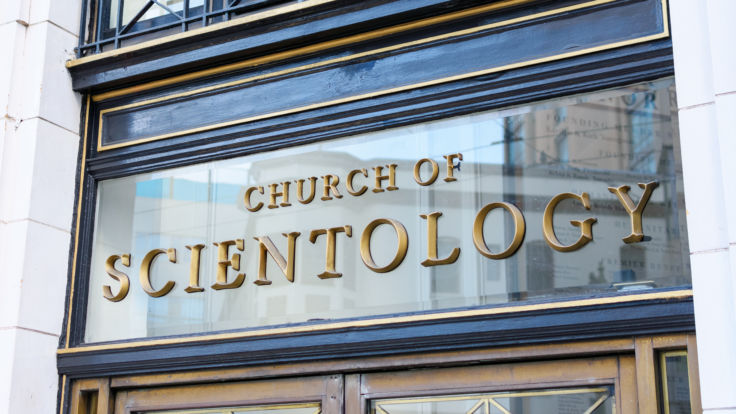
Last Friday marked seventy-six years since the foundational book for Scientology, Dianetics, was published. Born in 2003, I was privileged enough to grow up in a world where commercials for Dianetics did not bombard our TV channels. For my generation, Scientology has become practically irrelevant—that is, up until a few weeks ago with reports of a new trend of Gen Zers and Gen Alphas filming themselves storming through Scientology buildings.
So what is this book anyway, and how did it lead to the creation of the “church” of Scientology?
Science fiction author L. Ron Hubbard wrote Dianetics in 1950, intending to give a “practical guide to help eliminate your negative emotions, insecurities and daily stress and anxiety.” His big theory was that when the mind stores memories during moments of traumatic “unconsciousness” (such as being anesthetized for a procedure or becoming delirious from an illness) this can cause fear, pain, and psychosomatic illnesses to develop. To free someone from these issues, they must be led to recount these “unconscious” experiences from beginning to end.
But what happens if your fear or pain can’t be traced back to an unconscious experience? This is where the theories of “past lives” developed. According to the Scientology website, “By use of the procedures of Dianetics it became apparent that the source of these conditions were not cells or cellular memory, but a beingness [sic] that defied time.”
This “beingness” is known in the Scientology world as a thetan. A thetan is the Scientologist version of a spiritual being, which all men are. It is immortal and lives countless lifetimes, with distinct urges toward survival. These urges are broken down into eight “dynamics,” with the first dynamic embodying the urge to have an individualized existence, and the eighth being the urge toward “existence as infinity” or the “Supreme Being”—their version of God.
The goal of Scientology is to help its members become aware that they are thetans and to restore their spiritual abilities through counseling, or “auditing,” sessions, the study of Hubbard’s work, and training courses. Through the completion of these tasks, one can reach the state of “Operating Thetan” (OT), allowing him to “willingly and knowingly be at cause over life, thought, matter, energy, space and time.” This sounds an awful like God, but according to the church, one does not become God but becomes “more like oneself.”
If you’re like me, you might be wondering: what the heck does that actually mean? And who the heck has these magical powers? Well, the church suggests that in reaching OT, you gain control over yourself and your environment. Those who have claimed to reach OT describe having complete control over their emotional state, control over their friends and family, and even control over the weather…But that’s “not God.”
Don’t worry, though—these abilities aren’t available to just anyone. According to ex-scientologists Leah Remini and Mike Rinder, “it wouldn’t be out of the ordinary for an individual to spend approximately $500,000 to reach the top tiers.” Only the rich can afford these powers.
So maybe that’s how Tom Cruise got so good at his stunts…