



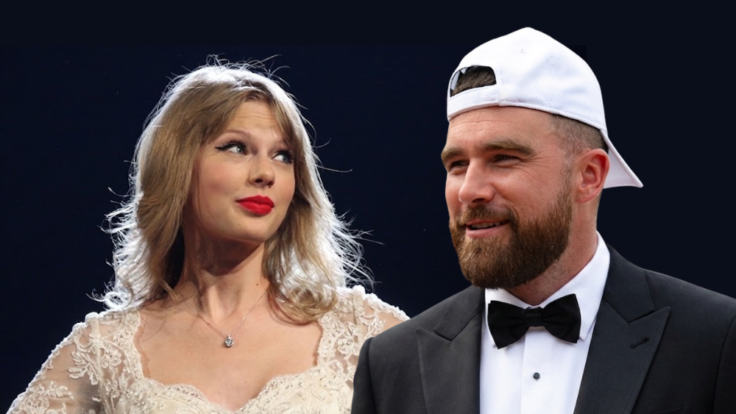
I had a prior commitment last Friday, so I was unable to attend the gala nuptials of Taylor Swift and Travis Kelce.
Neither will I be sending a gift—what do you get the man and woman who own a $54 million jet?—but they have my sincerest best wishes. I know there has been some cynicism about the oxygen-sucking nature of their public courtship and about the long-term marriage outlook for a woman who made her fortune writing breakup songs. Still, in a generation where marriages are later and less frequent than ever before, I entertain some hope that the union of America’s most powerful couple may be a positive encouragement to the anxious single masses.
And make no mistake: a union it surely is. I have written before about the weird juridical power that canon law holds over baptized Catholics, even those who don’t practice or even have never practiced the Faith—requiring them to marry in a rite according to canonical form (or get a dispensation from it) or else their attempted unions will be invalid. Not just illicit, that is, irregular or contrary to the law, but in fact Not Marriages at all.
Non-Catholics, however, operate under no such burden. So, even though the Swift-Kelce wedding venue was not a church but the place where the New York Rangers won the 1994 Stanley Cup, and even though the minister was Happy Gilmore, Trav & Tay are now validly one flesh. In fact, since both were raised Christian, there is a good chance that they were baptized and so are now sacramentally united in an absolutely unbreakable bond (see can. 1055 §2).
How can we presume that they are really married? After all, it has become hip in some pastoral circles to say that huge percentages of marriages are actually invalid, due to some murky psychological defect in one or both parties. Don’t you have to know, I mean really know and deeply understand, what marriage is? Don’t you have to possess a level of personal maturity and wisdom that fewer and fewer people in our spiritually wounded age can muster?
No. Marriage is a primordial institution fitted to mankind’s nature, the second-most-common thing in human history—not something foreign and rare like the object of a fantasy quest.
From a Catholic perspective, what does it take to have a valid marriage like Mr. and Mrs. Swift-Kelce’s?
First, you need the ingredients for marriage: a) one man and one woman who are b) able to marry.
You can’t marry a pet, or yourself. Same-sex couples and polyamorous groupings are out. You have to be old enough. Canon law fixes specific ages for Catholic marriages, and historically it’s around the age of sexual maturity, but civil authorities can regulate this differently in reasonable ways. Being able to marry also means having the mental capacity to give consent and the physical ability to consummate the marriage.
Ability to marry requires the freedom to marry. You can’t be bound by a prior union or vow, or be under coercion. And, in most places, the ability to marry a particular person includes not being his or her close blood relative.
If you have assembled the ingredients for the marriage recipe, it’s time to combine and bake them. This happens with consent. Yes, for the purpose of civil marriage, which the Church generally recognizes, some legal form is required (in our example, a quiet city hall ceremony preceded the bash at Madison Square Garden). There’s a license to buy and paperwork to sign.
But it is mutual consent that causes the marital bond, whether natural or sacramental, to come into being. Man and woman agree to take the other as spouse in a union that they intend to be a) exclusive, b) lifelong, and c) ordered to common living, and, as may be possible, to the bearing and raising of children. This, too, is straightforward, and takes for granted basic human agency and integrity. As canon law (1101 §1) specifies, the “words and signs” used by the man and woman to express consent are presumed to communicate what they really mean.
Now, the words and signs of matrimonial consent are contained in the vows, and vows can vary from place to place and couple to couple. We can imagine vows that don’t properly communicate matrimonial consent: for example, promising to stay married for “as long as love shall endure” instead of “as long as you both shall live.” But most of the time, whether standing before a religious minister or a justice of the peace, people sufficiently consent to the key basics: I take you and nobody else. We intend it to last for life. We’re going to make a family.
I find it amazing and encouraging how, after all the violence our culture has done to marriage, the vast majority of people who attempt marriage are still on the same page. So powerful still is the innate sense of what marriage is, both in our natural instinct and as a remnant of Christian civilization.
How long it will stay this way is a fair question. Maybe when the next big generational celebrity wedding happens, things will have changed. But in the meantime, I wish Taylor and Travis many happy years—and many eager imitators.
Image credit: Original photo by Erik Drost via Flickr, modified by Emily Dinneny, licensed under CC BY 2.0
Original photo by Eva Rinaldi via Flickr, modified by Emily Dinneny, licensed under CC BY 2.0
