



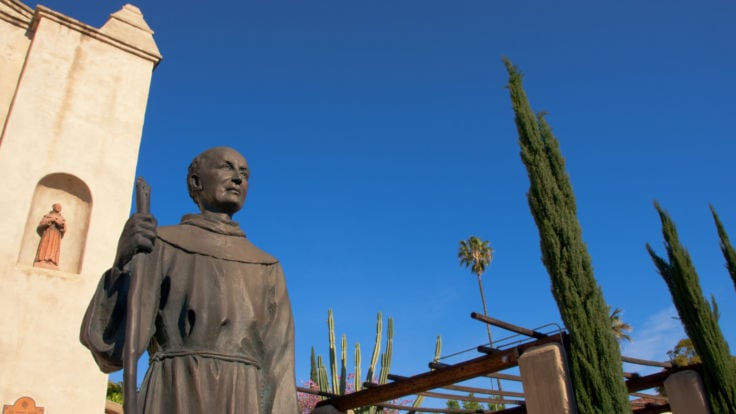
Today, the Church celebrates Saint Junípero Serra. But I’m certain most of the people who now inhabit the land he founded do not.
Is it overstating things to call Serra the founder of California? The principal cities of the Golden State started as Spanish Missions, the first nine of which he founded. Interstate 5, or “The Five” in Southern Californian dialect, essentially traces the path of the Camino Real. The Spanish “Laws of the Indies”—under which he operated—codified a vastly more humane treatment of the indigenous peoples of the Pacific coast than anything the Eastern Seaboard natives had ever experienced. Indeed, Serra himself penned his Representación, which Pope Saint John Paul II called a “bill of rights” for California’s natives.
The charges now flung at Serra are more histrionics than history. They pile on him all the sins of the Spanish empire, making the implausible claim that Serra abandoned a good career as a department head at the University of Mallorca to face the perils and privations of a transatlantic voyage and the hardships and uncertainties of the California wild—to say nothing of walking over the course of a lifetime (on a wounded leg no less) roughly the circumference of the earth—all for the pleasure of enslaving and exploiting natives. In fact, Serra was the Indians’ chief defender against unscrupulous and cruel soldiers and politicians. He came to give, not take. He exhausted his body to bring the people of California the thing they needed most: baptism.
It’s fitting that Serra’s feast should fall so near Independence Day, and this year to our semi-quincentennial. The Franciscan friar whose bones rest today at the Carmel Mission never saw Philadelphia. Nonetheless, when Spain entered the war against Britain, he rallied the citizens of California’s missions to pray for American victory. The Spanish Crown levied a war tax, but this Serra paid from the Mass stipends. The natives were never assessed.
From the opposite shore, from impoverished adobe churches and struggling settlements, came aid for a fight for liberty, the fruits of which Serra would not live to see. As we mark two hundred and fifty years, let us make room in our memory for this Catholic founding father of the West who planted the cross in California and helped prepare a corner of the republic before the republic even knew its name.