



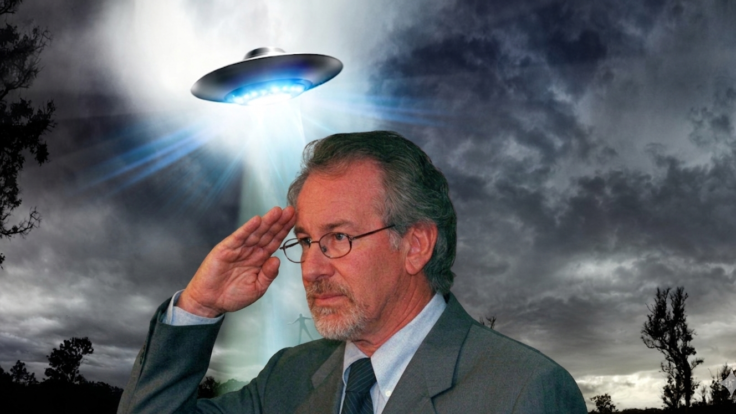
The leadup to today’s opening of Disclosure Day has been quite an exercise in hype, hasn’t it? Coinciding with peaking interest in what old people call UFOs (now “UAPs”), and government declassification of some records concerning same, the movie seems to have caught the crest of a massive cultural wave that it will surely ride all the way to the pleasant shoreline of Cash Beach.
Director Steven Spielberg has masterfully nurtured that connection with a series of interviews that seem to treat his movie as a documentary rather than a bit of summerweight popcorn fiction. Indeed, his musings about the effect of alien “disclosure” on human society and on religious belief have led to speculation that he is part of a master plan to soften up humanity for a coming real-life alien revelation—or maybe a still-more sinister purpose.
I don’t know if mankind is being set up for disclosure; I do know that it wouldn’t disintegrate the basis of Christian faith like Gort’s death ray if it happened; and I’m not sure whether such beings, if disclosed, would be natural or preternatural (and it’s probably better if I don’t venture an opinion on that question, either).
Whatever the truth about extraterrestrial life turns out to be, I don’t think that Spielberg and his new film are simply shills for some disclosurist cabal in government, tech, and media.
One reason is that Spielberg is a showman and a businessman—arguably the greatest combination of these traits in movie history. This means, firstly, that his primary motive is always to entertain and to make a buck while doing it. There’s no reason to watch his promotional interviews and conclude they have any other purpose.
Secondly, it means that, like a thousand other such celebrities, Spielberg has an inflated sense of the value of his opinions in other areas and believes the world needs to hear them. The phenomenon of entertainer know-it-all-ism is familiar enough to us normies. Why should we conclude that, in this one case, when Spielberg pontificates it’s because he actually possesses secret gnosis?
But the bigger reason why I don’t think the Jaws director is blazing a trail for our new alien overlords to destroy the foundation of Christianity is this: he has been playing that same note in his movies for decades. Connect the dots in his filmography and there emerges a clear picture of a man trying to heal his God-wound with his imagination.
Spielberg was raised a Jew, and as a teenager he had been wrestling both with cultural antisemitism and with internal conflict between his received beliefs and modern secularization when his parents divorced. Though the cause was his mother’s infidelity, he blamed his father and became estranged from him for decades. He would go on to speak candidly about the ways he sought to work through the pain and loss in his art.
One theme that emerges repeatedly in those films is that of parental loss combined with (and often healed by) the intervention of powerful other-worldly figures exercising, in God’s apparent absence, divine agency.
- E.T. features an alien who literally heals the heart of a boy who lost his father to divorce. The creature assembles a ragtag group of followers, is captured by authorities, dies, is resurrected, and then ascends back to the heavens. (After telling them to “be good” and assuring them he’ll remain within their hearts.)
- In Close Encounters of the Third Kind, a single mother is reunited with her fatherless son through the intervention of benign celestial creatures who exhibit godlike power over time and space. Another character loses his family over his alien obsession but finds peace when he is allowed to board the mothership.
- AI: Artificial Intelligence features a lonely android boy who yearns for but is denied real familial love—until powerful alien/evolved robotic beings allow him to simulate it and die happy.
- The War of the Worlds turns the classic H.G. Wells story about alien invaders into a tale of reconciliation between an estranged father and his children, banding together to face the alien threat.
- In The BFG, the magical uber-character is a giant, not an alien—but his appearance introduces an orphan to paternal love and to hidden fantastical truths.
It seems clear enough that we should view Disclosure Day as part of the same pattern. Spielberg isn’t dutifully spoon-feeding alien disclosure to the masses; but he is still exploring the idea of a cosmic God-substitute that will bring fulfillment where his religion and his family life, for reasons ultimately known only in the depths of his soul, have left him wanting.