



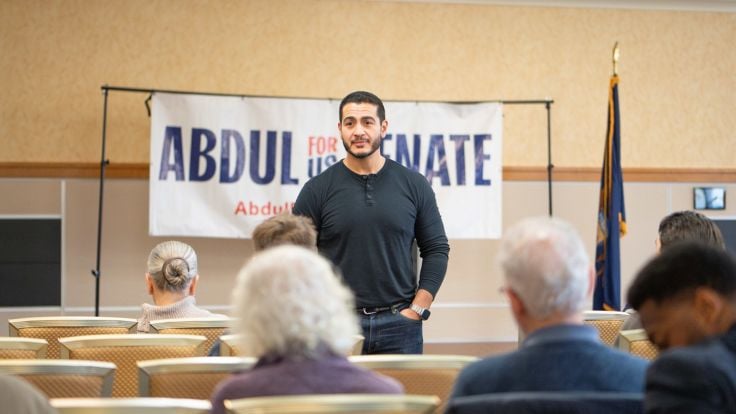
Michigan physician and U.S. Senate candidate Abdul El-Sayed is rightly catching flak for one odious comparison he made in a recent interview with journalist Jesse Watters. But a second, less reported one, was no less ridiculous.
The first, of course, was his response to Watters’s question about whether he supported the transgender agenda. On this subject, El-Sayed’s party is in the thrall of its most radical constituents. Even though clear majorities of Americans across party lines oppose sex-reassignment surgeries and chemical experiments for minors and oppose participation in women’s sports by biological males, El-Sayed knows he has to hew to the foursquare trans doctrine.
Thus, when asked if he supported the mutilation of boys’ genitals in the name of “gender-affirming care,” he turned the challenge on his questioner, shooting back, “Are you circumcised?” Watters’s flustered reaction allowed El-Sayed to posture as if he had dropped the mic with a brilliant and unanswerable counter: “Okay, so you should probably want to move on.”
(No, circumcision—which is performed on male babies as a Jewish religious rite today just as it was on Our Lord, and also on some gentile babies for perceived health or cosmetic reasons—is not the sinful act of mutilation, which destroys or damages the function of a bodily member.)
For obvious reasons, this exchange has gotten a lot of air. But at another point in the interview, El-Sayed offered another howler. When Watters asked El-Sayed, who is Muslim, about his past expressions of support for Sharia law in the United States, he replied,
Do you know what canon law is, Jesse? … canon law is the name for Christian law… Nobody is trying to push Sharia law on anyone else. Just like I hope nobody is trying to push canon law on anybody else, because we live in an America where you should have the freedom of your religion.
Did Watters know what canon law is? Even most Catholics couldn’t give an adequate definition, so probably not. It’s even less likely that El-Sayed knows—or cares, beyond making a false equivalence to advance a talking point.
To many viewers it might have seemed, however, that El-Sayed was actually making a strong point. Why are we only talking about Muslims imposing their law? Christians have a “law,” too. I just hope they won’t impose it on society just like we don’t want Muslims to impose theirs. Coming from El-Sayed, there’s both a gotcha element (Christians have been promoting their secret law all this time!) and a winsome plea for pluralistic tolerance.
Are the two laws comparable? Or are they as dissimilar as castration and circumcision?
Sharia is a broad term for codes of Muslim conduct, derived from the Quran, the example of Mohammed, and Islamic religious and legal tradition. There is no single expression of Sharia’s rules, which are filtered through different Muslim schools of jurisprudence, but they generally encompass a wide swath of human life: prayer and religious observance, marriage and family, legal rights and contracts, finance, diet, dress, myriad moral matters, and more.
In many countries that are predominantly Muslim, Sharia is deeply embedded into civil and criminal law, with its prescriptions, judgments, and punishments serving a governing function. In light of this, Sharia has become a flashpoint of controversy in certain Western nations where Muslim-dense locales experience conflict between local law enforcement, based on liberal Western values, and neighborhood Muslim councils dispensing gray-market Sharia judgments that often contradict those values.
The majority of these hot spots are in Europe, but as Islam grows in certain regions of the United States, there has been talk of measures to prevent that kind of “parallel justice” from taking root here. This was the context of El-Sayed’s defense of Sharia and Watters’s line of questioning.
Canon law, although in a few ways perhaps superficially similar enough to Sharia for a quick name-drop on cable TV, is radically different in many more ways that matter.
It is not “the name for Christian law” as El-Sayed claimed. First, because it is virtually unknown in Christian groups outside of Catholicism and Orthodoxy, whereas variants of Sharia operate throughout the Muslim world.
Moreover, because calling it “Christian law” implies that, like Sharia, it covers many or most areas of Christian life and society. It does not. Canon law is inherently ecclesial and thus inherently limited. Its laws, or canons, regulate how the institutional Church governs itself: how dioceses, parishes, and Catholic associations are organized and operate, the ecclesial rights and obligations of the faithful according to their state in life, fine print related to the niceties of religious education and sacramental celebration, especially the sacrament of matrimony, and lots of eye-glazing procedural verbiage that most Catholics will never have to know.
Unlike Sharia, Catholic canon law is not about superimposing a full spectrum of doctrinal and moral teaching onto the everyday life of religious adherents. It is more like a thick binder of organizational bylaws.
Canon law’s jurisdiction is as limited as its scope. Where Sharia can expand to fill large roles in a state’s civil and criminal courts, canon law stays in its lane. Majority-Catholic countries don’t ban meat on Fridays (though they might have organic traditions of Friday abstinence). The Catholic immigrants who packed America’s urban ghettos in the early twentieth century didn’t go around dispensing back-alley annulments.
That El-Sayed’s first thought would go to a “canon law” that gets “pushed” on people says as much about his Sharia mindset as it does about his ignorance. Don’t be bullied by his phony whataboutism.
Image credit: Conlan Houston, via Flickr, CC BY-SA 4.0.