



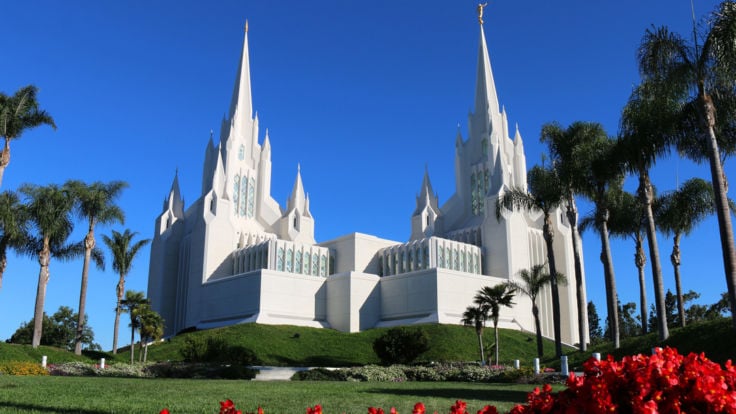
Most of San Diego’s attractions are close to sea level: the beaches, the taco joints and surf shops, the Mission and the Midway. Unless it’s to admire the pleasant rolling ridges, generally there’s little reason for tourists to lift their heads to look at anything.
One exception is the Mormons’ San Diego California Temple, which towers over the 5 freeway just north of downtown like an origami Chartres. Its gleaming white façade and angular spires never fail to crane the necks and draw the eyeballs of passers-by.
Ordinarily, that’s all that non-Mormons ever get to see, as admittance to temple interiors, once they are officially dedicated, is permitted for the faithful only. But after a comprehensive interior renovation, before the space is re-dedicated, San Diego’s temple has been opened for public tours for a few weeks this summer. I secured a ticket and visited yesterday.
The experience was a mix of the expected and the surprising.
Members of the Church of Jesus Christ of Latter-Day Saints enjoy a reputation for wholesomeness and good cheer, and on this score, the countless smiling volunteers who processed the throngs of visitors (both local and bussed in from afar) did not disappoint. Everyone—from the young boys in dress shirts and ties who affixed white booties to our shoes at the entrance, to the bright-eyed teens who lurked with greetings around every corner, to the kindly elders leading the tour groups—was uniformly welcoming, helpful, and upbeat.
And, though there was no overt proselytism, they matched their friendly manner in the sincerity with which they testified to Mormon faith and practice. (More on that in a moment.)
The surprising? Well, here I’ll try my best to be diplomatic but direct. Anybody expecting an interior to match the ambition of the exterior would be in for a letdown. A Catholic who thought he would find a mildly Mormonized version of a Western-style cathedral would be shockingly disappointed.
Inside that massive structure, we tour-takers discovered, there is no great central worship area evoking awe and transcendence. There is neither the vaulted airiness of the Gothic nor the sumptuous sensual abundance of the Baroque. As far as I could tell, there is no attempt at all to convey sacredness, that is, set-apartness from ordinary worldly experience. Rather, it’s a labyrinth of prosaic meeting spaces and comfy sitting zones: all deep carpeting, crushed velour, padded seats, mirrored walls, and gold-lamé bunting, ringed by shiny bronze and chrome accents and lit by prismatic crystal chandeliers.
The corridors and atria linking the main areas—rooms for the main Mormon “ordinances,” flex spaces for group instruction and wedding parties, large his-and-hers changing rooms for donning ceremonial white worship garb, and an expansive contemplation lounge called the “Celestial Room” that I believe we were to take as the high point of the tour—gave the practical, multipurpose vibe of a parish hall built to the latest code. The white walls were broken up every few yards with framed paintings, in that earnest, colorful style recognizable from Mormon literature, depicting familiar biblical scenes, Jesus embracing ancient native Americans per their own ersatz revelation, and various LDS believers in peaceful, prayerful poses.
We were not permitted to take photos or video, but you can see professional shots of the renovated interior here.
Like I said, everyone was awfully nice. I won’t judge taste. I will just say that almost nothing inside that temple resonated with what I know and have experienced of traditional Christian sacred architecture. And, given the intense LDS desire to be viewed as full members of the Christian tradition, that was unexpected.
Although there was no hard sell on Mormon doctrine, there were two areas where our tour guides did press a bit: first, a short apologetic, claiming St. Paul as an authority, for the Mormon practice of baptizing dead ancestors into the faith; and second, a witness by a married couple to the Mormon belief in an everlasting marriage bond. The latter was punctuated by an invitation, inside the wedding chamber, to gaze into a set of opposing mirrors that produced an “infinity” effect.
In my moderate experience with Mormon missionaries, I have found this to be their most attractive claim, this appeal to natural bonds of family. Christianity says that our forebears have been judged and their fates crystallized, and that there will be no marriage in the hereafter. But Mormonism offers a warmly appealing alternative: all your past family can be retroactively brought into divine communion, and your present family will endure forever.
If we are to witness to our LDS brothers and sisters in order to bring them to the orthodox Christian faith, I think we need to be ready to speak to this subject. And also to invite them, with matching hospitality, to visit our beautiful churches and cathedrals—no ticket required.
(Image credit: Pam Burt, via https://churchofjesuschristtemples.org/.)