




One prominent online Evangelical—Ryan at needGod.net—uses cartoons to depict Christians who believe their actions affect their salvation as struggling for salvation, while those who adhere to salvation by faith alone as having perfect, peaceful assurance of their salvation.
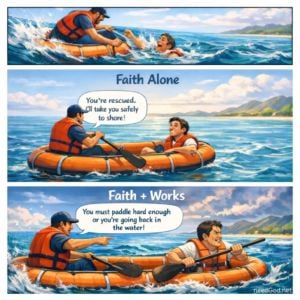
But those cartoons contradict Ryan’s message.
In the cartoon featuring the man paddling to safety, paddling represents good works. The cartoon paints salvation by faith alone as never having to do any good works at all. You can even gravely sin through inaction—such as by never praying to God—and you’ll still be saved.
But Ryan’s theology, like most Evangelicals’, says good works are an essential sign or proof that you’re saved. That means the cartoon should really depict “faith alone” as identical to “faith plus works,” but with the other guy in the raft saying, “Paddle hard because that’s a sign you’re truly saved and if you don’t paddle hard enough, that proves you weren’t saved in the first place!”
When put this way, this Christian will not rest peacefully, but will likely become robbed of his assurance of salvation because if he gravely sins, this leaves him doubting that he was ever saved in the first place.
In reality, salvation is not a matter of doing enough good work to earn heaven. It’s a matter of receiving God’s grace and not permanently forsaking it. That’s the only “good work” we must do to enter heaven. And the Bible clearly teaches our salvation depends on things we do. In the Sermon on the Mount, Jesus says:
“Not every one who says to me, ‘Lord, Lord,’ shall enter the kingdom of heaven, but he who does the will of my Father who is in heaven. On that day many will say to me, ‘Lord, Lord, did we not prophesy in your name, and cast out demons in your name, and do many mighty works in your name?’ And then will I declare to them, ‘I never knew you; depart from me, you evildoers.’” (Matt. 7:21-23).
This should terrify us. Even if we do good works that please God, that won’t matter if we live a hypocritical life and gravely disobey God without repenting before death. That’s why Paul says in Romans 2:6-8 that
“[God] will render to every man according to his works: to those who by patience in well-doing seek for glory and honor and immortality, he will give eternal life; but for those who are factious and do not obey the truth, but obey wickedness, there will be wrath and fury” (emphasis added).
In the Bible, “faith” is not merely the act of acknowledging Jesus has done something for us and thanking him for what he’s done, which is how many Evangelicals (like Ryan) define faith. Instead, a significant part of Paul’s conception of faith derives from the concept of faithfulness. Faith is not just trust or confidence in someone; it is obedience to that person because he is so trustworthy. John 3:36 puts it well: “He who believes in the Son has eternal life; he who does not obey the Son shall not see life, but the wrath of God rests upon him.”
Our faith, like our lives, is not of our own doing. It is a gift from God. However, we can choose to deny this gift and forfeit our salvation if we disobey God. This is why the Catholic Church emphasizes the importance of drawing near to God, so that we may faithfully persevere to the end (Matt 10:22).