



Audio only:
TRANSCRIPT:
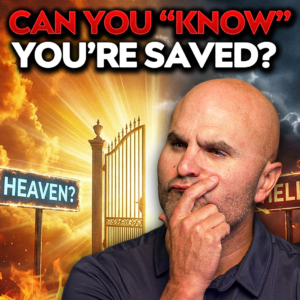
Does John teach that once you accept Jesus as your Lord and Savior, and live your life for him, you can be absolutely sure—without a doubt—you’re going to heaven? Many Christians say yes. And they quote 1 John 5:13 to prove it. John writes, “I write this that you may know that you have eternal life.” But does this mean what they think? Spoiler alert: it doesn’t!
Hey guys, Welcome back to the channel! So glad to have you with me. If you haven’t done so already, don’t forget to subscribe to the channel. Also, I’d like to invite you to consider helping keep this podcast going by financially supporting us on Patreon at doctorkarlo.com, with “doctor” spelled out.
So, as I said, some Christians believe John teaches in 1 John 5:13 that a believer can be absolutely sure he’s going to heaven.
A simple google search will show a plethora of hits where pastors give sermons on this passage. But here’s one, just to give you a sample. It comes from Mission Bible Church in Costa Mesa, CA.
[VIDEO]
….these things i have written to you who believe in the name of the son of god verse 13 here’s our purpose clause in 40:06 order that you may what 40:13 you may know number four true salvation you can know that you have it 40:19 you can know that you have it he says i’m writing this so that you would know 40:26 that if you read the word and you believe the christ and it’s the right christ you can know 40:32 and that’s the theme of this gospel he wants us to know he wants the christian to know and he 40:38 wants the false convert to know he wants everyone to know who’s in and who’s out 40:48 god wants you to know not to wonder not to worry not fuzzy not speculating with your fingers crossed with a sweaty brow 40:55 wringing your hands and walking around going i’m not sure no god wants you to know
….…. he wants you 41:40 to know that christ is in you the hope of glory and then when you wake up every single morning you know that you know 41:45 that you know that you know that you know that you’re saved 41:50 that’s why john writes this
Now, just so you know this pastor is appealing to 1 John 5:13 for the assurance of salvation, here’s what he says toward the beginning of his sermon as he’s teeing it up:
[VIDEO]
…..another disclaimer that’s very important 8:02 as we begin to talk about what theologically is called the assurance of salvation is this this is an important 8:09 disclaimer which i’ll bring up many times throughout our nine or ten weeks together which is that 8:14 assurance of salvation comes ready for this from god alone 8:22 you are not assured of your salvation from a parent from a pastor 8:29 from a pope from a priest from a confirmation class 8:34 or a decision counselor true assurance of salvation true certainty only comes from the spirit of 8:41 god through the word of god okay.
Notice this pastor spoke of the “assurance of salvation” four times in that clip. But some might wonder which kind of assurance does he have in mind—a confident assurance, where it’s possible you’re wrong, or an absolute assurance, where all doubt is excluded. Well, here’s what it says in the video’s description:
John the apostle writes his epistle so that true Christians can be sure of their salvation, while false converts will reexamine their lives. In this opening sermon, we’ll learn of John’s nine vital signs, and how a believer can know, beyond any doubt, that he is a child of God.
Now, lest you think this is argument doesn’t have any credibility because it’s coming from some pastor on YouTube, the late Norman Geisler made this argument in his contribution to the book Four Views of Eternal Security. He sees 1 John 5:13 as evidence for having, in his words, “true assurance of eternal salvation” (pg. 78).
And by “assurance” he means absolute assurance—that’s to say, without a doubt.
So the question is: Does John actually mean what these Protestants think he means?
I’m gonna argue—no, he doesn’t.
Let’s start with that word: “know.”
The word “know” can be used in different ways. Sometimes, it means absolute certainty—like when I say, “I know that 1 + 1 = 2,” or “something cannot both exist and not exist at the same time and in the same respect.” That’s infallible knowledge. No error possible.
But other times, we use “know” to describe something more like a strong confidence.
For example, I might say, “I know I’m going to ace my philosophy exam.” Why? Because I studied hard, I know the material. But—realistically—I could still mess up and get a B. It’s not infallible knowledge. It’s more like a reasonable expectation, or a confident assurance.
So just because John says his readers “know” they have eternal life, it doesn’t automatically mean he’s talking about absolute assurance—the kind of assurance that excludes all doubt.
The real question now becomes:
Well, which kind of “knowing” did John have in mind?
Some Protestants will say, “Well, of course it’s absolute certainty!”
And they’ll point to verses like John 3:16:
“Whoever believes in him will not perish but have eternal life.”
And since 1 John 5:13 is addressed to people who already believe in Jesus, they argue these folks can be absolutely certain they’ll go to heaven.
But here’s the problem:
John doesn’t just talk about believing. He talks about continuing to believe—persevering in faith.
Take a look at 1 John 2:5:
“Whoever keeps his word, in him truly the love of God is perfected. By this we may be sure that we are in him.”
Then a few verses later, in verse 24, he writes:
“Let what you heard from the beginning abide in you. If it does, then you will abide in the Son and in the Father. And this is what he has promised us: eternal life.”
Notice that key word: “if.”
Eternal life is promised if the message continues to abide in them.
What’s “the message”? Jesus is the Christ and we need to believe in him—and, as John makes clear in 1 John 3:11, love of neighbor too.
So according to John, it’s not just about having faith once. It’s about remaining in faith and living in love. That is what’s necessary to remain in the Son and the Father.
And since abiding in the Son and the Father is how we have eternal life, it follows that continuing in faith and love is necessary to have eternal life.
Now, this whole idea of perseverance comes straight from Jesus himself.
In Matthew 10:22, Jesus says:
“He who perseveres to the end will be saved.”
We know that the “perseverance” Jesus is talking about is continued belief in him, and that the “salvation” he’s talking about is eternal salvation, because just a few verses later in verses 32-33 he says,
“Everyone who acknowledges me before men, I will acknowledge before my Father… but whoever denies me before men, I will deny before my Father” (vv. 32–33).
So, our eternal salvation—being counted among the elect—is tied to whether we continue to acknowledge Jesus publicly.
That’s perseverance.
Now that we know John believes faith must be persevered in, here’s the next logical question:
How could John’s readers know—with absolute certainty—that they’ll persevere all the way to the end of their lives?
They couldn’t know through reason alone—There’s no philosophical argument that can tell you, me, or John’s readers whether God will give us or them the grace of final perseverance. Grace is something beyond our nature, given to us as a gift from on high due to God’s free choice. And our reason—by itself—simply can’t give us access to that inner world of God’s being, access we’d have to have for us to figure out for sure whether he’s chosen to keep us in grace.
John’s readers also couldn’t know through public revelation—The Bible never names any of John’s readers as members of the elect. There’s no verse that says, “Hey, Joe in Ephesus—you’re guaranteed heaven.”
The only other way someone could know with absolute certitude that they’ll persevere in faith unto death is through private revelation—Jesus personally appearing to them and saying, “You’re good. You’re going to make it.”
But I think it’s safe to assume that John’s readers didn’t have that kind of experience. Or at least John doesn’t say anything to suggest they did.
So, if those are the only ways John’s audience could’ve had absolute certainty they’d persevere in faith—and none of them apply—it makes sense to say that John isn’t talking about that kind of rock-solid, infallible knowledge that excludes all doubt that some Protestants think. Instead, he’s talking about a kind of confident hope or reasonable assurance.
Now, a Protestant might push back and say, “Wait! What about the inner witness of the Holy Spirit?”
Paul says in Romans 8:16:
“The Spirit himself bears witness with our spirit that we are children of God.”
Let’s assume for argument’s sake this entails the degree of certainty argued for here—here’s the thing:
Being a child of God now doesn’t guarantee you’ll inherit eternal life later.
Just like in real life: being someone’s child doesn’t automatically mean you’ll get the inheritance. You can lose it.
So even if the Spirit tells us we’re children of God, that doesn’t mean we have absolute assurance of final salvation. It’s not the same thing.
So here’s the bottom line:
John, just like the rest of Scripture, teaches that we have to persevere in faith and love to receive eternal life finally at the end of our lives.
And as we’ve seen, John’s audience couldn’t have had absolute certainty that they would persevere—because none of the ways to get that kind of certainty apply to them.
So, when John says in 1 John 5;13 “you may know that you have eternal life”, he’s not talking about infallible, can’t-lose-it, once-saved-always-saved kind of knowledge.
He’s talking about a confident expectation—a hope grounded in faith and love.
And honestly, that’s more biblical.
Even St. Paul didn’t claim to have absolute assurance. He writes in 1 Corinthians 4:4:
“I am not aware of anything against myself, but I am not thereby acquitted [or justified]. It is the Lord who judges me.”
Now, while we can’t have 100% certainty, that doesn’t mean we’re left in the dark with no certainty.
The Catechism of the Catholic Church says in paragraph 2090 that through the virtue of hope, we can have a “confident expectation of divine blessing and the beatific vision of God.” Such confidence is not nothing—it’s a real assurance, just not absolute.
Also, we can have real knowledge, though imperfect, that we’re currently in a state of grace—and this is known through signs. St. Thomas Aquinas talks about this and tells us about some of these signs in the second part of the first part of his Summa Theologiae, question 112, article 5.
For example, I’m conscious that I delight in God—that’s evidence that I’m in a state of grace.
I despise the evil things of the world—I couldn’t do that unless I had grace in my soul.
Also, like Paul says in 1 Corinthians 4:4, I’m not conscious of any mortal sin on my soul. This gives me good reason to think I’m in a state of grace.
But I can’t go all the way and say this with absolute assurance, because—and I would guess this is your experience as well—self-deception is real. As Jeremiah 17:9 says,
“The heart is deceitful above all things, and desperately corrupt; who can understand it?”
Now, I want to repeat—though this knowledge is imperfect it’s nevertheless real knowledge. And that’s something we can rejoice in.
So, no—1 John 5:13 doesn’t teach we can have an absolute assurance that “once we’re saved, we’re always saved.”
It teaches confident hope, not absolute assurance.
Well, my friends, that’s it for today! If you found this video helpful, make sure to like, subscribe, and share it with someone who might need to hear this. And for more resources, check out my website at karlobroussard.com.
If you want me to come and speak at your event, visit catholicanswersspeakers.com.
Lastly, I’d love for you to consider supporting me over on Patreon. I can’t continue doing this podcast without your financial support. You can find me over at doctorkarlo.com with “doctor” spelled out.
Thanks for hanging out, and I’ll see you next time!