


St. Ignatius of Loyola was a Spanish soldier whose dramatic conversion led him to become a priest, spiritual writer and guide, and founder of the Society of Jesus, commonly known as the Jesuits. His life shows how God can redirect even our strongest ambitions—and related trials and disappointments—toward holy fulfillment (Rom. 8:28; see 2 Cor. 12:8-10).
The Catholic Church celebrates the Feast of St. Ignatius of Loyola on July 31, the anniversary of his death in 1556. He is especially remembered for founding the Jesuits and developing The Spiritual Exercises, one of the most influential guides on spiritual discernment in Catholic history—and which has also positively impacted many Protestant Christians and non-Christians.
Who Was St. Ignatius of Loyola?
St. Ignatius of Loyola was born Íñigo López de Loyola in 1491 in the Basque region of Spain. Raised in a noble family, Ignatius dreamed of military glory, social status, and romantic adventure. He eventually became a soldier and built much of his identity around honor and personal achievement.
His life changed dramatically in 1521, when a cannonball shattered his leg during the Battle of Pamplona. While recovering, Ignatius asked for books about knights and heroic adventures. None were available, so he instead read books about the life of Christ and the lives of the saints, the close friends of Jesus.
Ignatius noticed something important as he read and prayed: thoughts of worldly success excited him temporarily but eventually left him restless and empty, whereas thoughts of serving Christ and imitating the saints brought him deeper and more lasting peace. This realization became foundational to his teaching on the discernment of spirits.
After his recovery, Ignatius abandoned his former ambitions and committed himself to God. He died in Rome on July 31, 1556, which is why his feast is celebrated on this date.
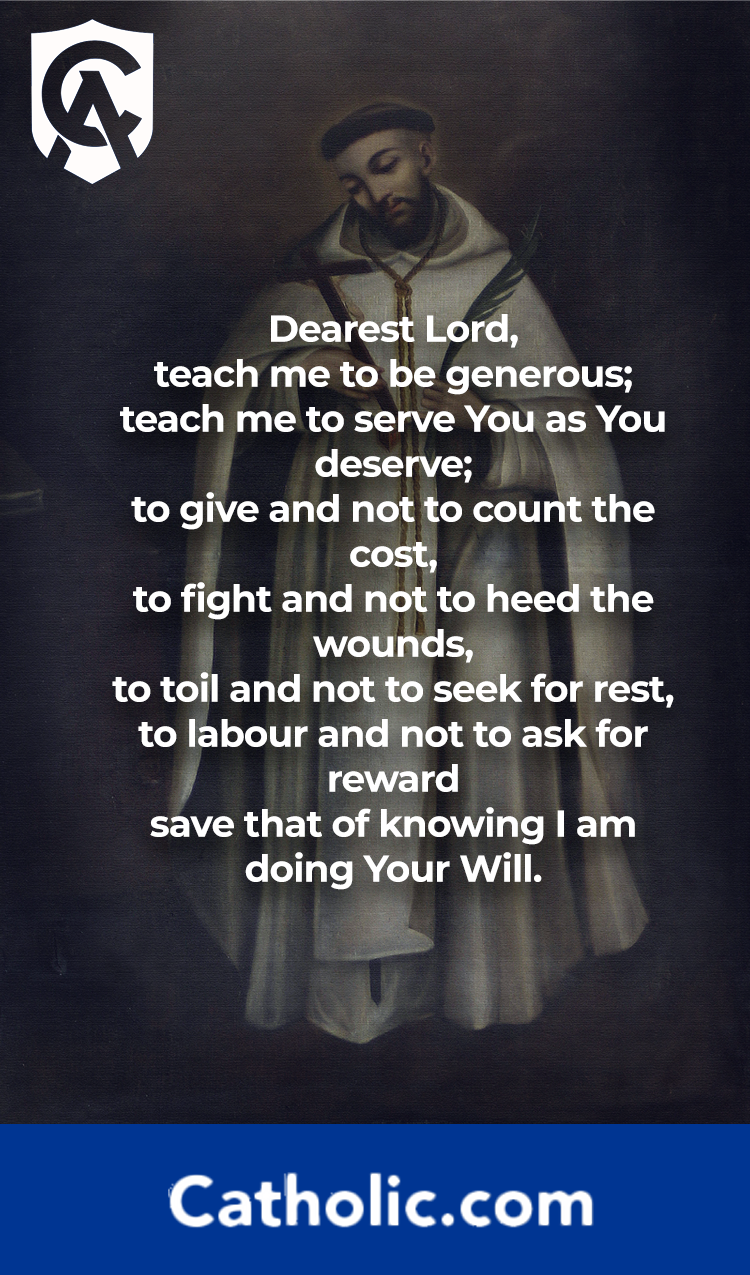
Free Download | St. Ignatius of Loyola Prayer Card
What Is St. Ignatius of Loyola Best Known for, and How Did He Found the Society of Jesus?
St. Ignatius of Loyola is best known as the founder of the Society of Jesus, a Catholic religious order whose members are called Jesuits.
Following his conversion, Ignatius spent time in prayer and penance near Montserrat and Manresa in Spain. He later pursued the education necessary for the ministerial priesthood. While studying in Paris, he formed a close group of companions that included St. Francis Xavier and St. Peter Faber.
In 1534, Ignatius and his companions made vows of poverty and chastity and placed themselves at the service of the Church. Pope Paul III formally approved the Society of Jesus in September 1540, and, in April 1541, Ignatius’s religious confreres elected him as the Society’s first superior general. Ignatius not only required of them the traditional religious vows of poverty, chastity, and obedience, but also a fourth: a special vow of obedience in serving the pope faithfully and wherever the pontiff would call a Jesuit.
Jesuit priests soon became known for missionary work, education, spiritual formation, and the defense of the Faith. They established schools, including many universities, preached the gospel in distant countries, and helped renew the Catholic Church during a period of religious upheaval that Martin Luther ignited with his revolt in the early 1500s.
Ignatius was canonized in 1622. Although he is not a Doctor of the Church, his writings and spirituality have had an enormous influence on Catholic prayer, education, missionary work, and religious life.
What Are The Spiritual Exercises of St. Ignatius of Loyola, and How Do They Teach the Discernment of Spirits?
The Spiritual Exercises are a structured series of prayers, meditations, examinations of conscience, and spiritual practices designed to help a person grow closer to God and make decisions according to the Lord’s will (see Matt. 6:33).
Ignatius developed the exercises based on his own experiences of conversion, spiritual growth and trials, and related prayerful discernment. The exercises are traditionally completed during a thirty-day retreat under the guidance of an experienced spiritual director faithful to the teachings of the Catholic Church, although a director can implement them over a longer period for a person who cannot take a month-long break from his ordinary life responsibilities. In addition, one can benefit from a shorter retreat, including for a weekend (i.e., 3-4 days), in which the director guides retreatants according to Ignatian discernment principles.
The Spiritual Exercises lead a person through several movements, sometimes called “weeks,” and thus there are four weeks for the thirty-days of a traditional Ignatian retreat. These weeks include reflecting on sin and God’s mercy, contemplating the life of Christ, meditating on his Passion, and rejoicing in his Resurrection.
A central part of Ignatian spirituality is the discernment of spirits. Ignatius teaches Catholics to pay attention to movements of spiritual consolation and desolation.
Consolation draws a person toward faith, hope, charity, repentance, and greater love of God. This consolation, if it is sustained and marked by true holiness, comes from the Lord, although, as St. Paul counsels, “even Satan disguises himself as an angel of light” for his deceptive purposes (2 Cor. 11:14; see 11:12-15). In marked contrast, desolation—which undoubtedly comes from the devil and his demonic minions (see Eph. 6:12)—produces spiritual darkness, discouragement, agitation, and temptation to abandon what is good. In addition, these movements should not be judged solely on one’s emotions, which are often volatile and misleading, nor should one evaluate himself in isolation. Rather, these movements must be tested through prayer, reason, Scripture, the teachings of the Catholic Church in general, and with the support of a faithful spiritual counselor, because we can be vulnerable to rationalization, discouragement, and even despair when attempting to discern on our own.
Ignatius provides fourteen fundamental rules for the discernments of spirits. The fifth and sixth rules of The Spiritual Exercises are especially important, and veteran retreat masters argue that we will navigate well 80-90 percent of our spiritual trials if we implement these rules faithfully. The fifth rule can be summarized as, “Never make a major decision in turmoil”:
In time of desolation never to make a change; but to be firm and constant in the resolutions and determination in which one was the day preceding such desolation, or in the determination in which he was in the preceding consolation. Because, as in consolation it is rather the good spirit who guides and counsels us, so in desolation it is the bad, with whose counsels we cannot take a course to decide rightly.
For example, one who has resolved peacefully to enter the seminary and study for the ministerial priesthood should not leave the seminary if he subsequently experiences desolation. Rather, he should maintain his commitment until he has attained anew a state of consolation, at which point he may peacefully reaffirm his decision to become a priest, or perhaps realize he’s called to serve the Lord and his Church in another state of life. Similarly, a person who has taken a job through sound, peaceful discernment (John 14:27), and then, in time, experiences desolation, should not precipitously abandon that job, lest he move forward on bad self-counsel and that of the devil. Again, major decisions should be made only through proper discernment that culminates in a solid state of spiritual consolation.
In the sixth rule, St. Ignatius provides guidance for navigating our trials of desolation:
Although in desolation we ought not to change our first resolutions, it is very helpful intensely to change ourselves against the same desolation, as by insisting more on prayer, meditation, on much examination, and by giving ourselves more scope in some suitable way of doing penance.
In navigating his own spiritual trials, Ignatius experienced scrupulosity and even suicidal thoughts. However, the Lord guided and sustained him through his struggles, which bore great fruit in his composition of The Spiritual Exercises. Not surprisingly, the devil and his demonic minions targeted St. Ignatius often during his life on earth, but the saint’s faithfully applying the rules of his Spiritual Exercises kept them at bay. After his death, the invocation of St. Ignatius’s intercession, as well as the use of his relics and images, have proven fruitful in major exorcisms and other spiritual warfare.
What Can Catholics Learn from St. Ignatius of Loyola’s Conversion, Ignatian Spirituality, and Life of Prayer?
St. Ignatius teaches that conversion is not merely a one-time, emotion-based decision. Rather, it is the gradual surrender of our plans, desires, and attachments to God, and thus a decision that grows stronger over time though our growth in holiness.
To help attain the surrender needed for growing in our relationship with God, St. Ignatius offers his well-known Suscipe (Latin: to receive) prayer:
Take, Lord, and receive all my liberty,
my memory, my understanding,
and my entire will,
All I have and call my own.You have given all to me.
To you, Lord, I return it.Everything is yours; do with it what you will.
Give me only your love and your grace,
that is enough for me.
In short, Ignatius’s counsel is not spiritual passivity but rather proactive availability to God in doing his will.
His life also shows that our personal ambitions are not necessarily supplanted in God’s plan. Rather, they can be redirected and purified. Ignatius once wanted to distinguish himself through military achievement. After his conversion, he pursued a much greater battlefield mission: serving Christ and thus helping souls gain heaven.
Ignatian spirituality encourages Catholics to examine where their thoughts and desires are coming from and also leading them. Do they produce humility, courage, charity, joy, and obedience to God, i.e., conforming to God’s battle standard, as Ignatius says in his Spiritual Exercises? Or do they produce self-absorption and pride, as well as confusion, discouragement, and even despair, i.e., conforming to Satan’s infernal standard?
His life remains a powerful reminder that holiness requires more than good intentions. It requires disciplined prayer, honest self-examination, wise discernment, and the sustained decision to follow Christ wherever he leads.
Commonly Asked Questions
- Who was St. Ignatius of Loyola? St. Ignatius of Loyola was a Spanish soldier who became a Catholic priest, spiritual writer and guide, and founder of the Society of Jesus.
- What are the Jesuits? The Jesuits are members of the Society of Jesus, a Catholic religious order founded by St. Ignatius and approved by Pope Paul III in 1540. St. Ignatius founded the Society of Jesus, or Jesuits, to serve the Church through missions, education, preaching, and spiritual formation.
- When is St. Ignatius of Loyola’s feast day? The Feast of St. Ignatius of Loyola is celebrated on July 31, the anniversary of his death in 1556.
- What are The Spiritual Exercises? The Spiritual Exercises are a series of prayers, meditations, and principles of spiritual discernment that that St. Ignatius developed to help Catholics and others overcome disordered attachments, deepen their relationship with Christ, and discern well the Lord’s will for their lives.
- What is St. Ignatius of Loyola the patron saint of? St. Ignatius is recognized as the patron saint of spiritual retreats, soldiers, and spiritual discernment in general.
- Was St. Ignatius of Loyola liberal? Modern political labels such as “liberal” and “conservative” are misapplied to this sixteenth-century saint. Ignatius supported reform within the Catholic Church while remaining firmly committed to the deposit of faith (CCC 84-87) which Jesus provided his Church (John 16:13; Acts 2:42)—and thus to the God-given primacy of authority of the pope in safeguarding that deposit (Matt. 16:18-19; Luke 22:31-32).
Related Content
Articles
From Evil God Brought Great Good
Tracts
Podcasts
How Do I Tackle Anxiety When Discerning a Vocation?
How Do I Know If God Is Talking to Me?
Q&As
Is There a Patron Saint for Discernment?
Is there any truth to the “Jesuit roots of dispensationalism” claim?
Shop
A Pilgrim’s Journey: The Autobiography of St. Ignatius of Loyola
Thinking Like a Saint: Discernment of Spirits in the Catholic Tradition