




Christians have always considered the bodily remains of their heroic martyrs to be their greatest treasures. Many of them were killed in the sports arenas of the day. They were champions who fought and won—didn’t cave under the fear, the pressure, or the pain. Refusing to recant their faith in Christ, they willingly sacrificed their lives for him. They recalled that he had laid down his life for them on the cross. To be worthy, they needed to do the same for him—and they did it willingly.
Calling the crowd to him with his disciples, he said to them, “If anyone would come after me, let him deny himself and take up his cross and follow me. For whoever would save his life will lose it, but whoever loses his life for my sake and the gospel’s will save it” (Mark 8:34-35).
St. Ignatius of Antioch boldly proclaimed his faith in Christ, and his willingness to be devoured by lions in the Colosseum in Rome, in the year 107. The holy bishop wrote, “Please let me be thrown to the wild beasts; through them I can reach God.” An eyewitness said,
Only the more solid parts of his holy relics [bones] were left, which were carried to Antioch and wrapped in linen—a priceless treasure bequeathed to the Holy Church.
In the year 155, eyewitnesses to the martyrdom of the aged bishop Polycarp of Smyrna recalled that
the centurion put [Polycarp’s] body in the middle . . . and burned it. And so, afterwards, we took up his bones, more valuable than precious stones and finer than gold, and put them in a proper place. There, as far as we were able, the Lord will permit us to meet together in gladness and joy and to celebrate the birthday of his martyrdom, both in memory of those who fought the fight and for the training and preparation of those who will fight.
The apostles suffered similar gruesome deaths for their Lord. Their memories are preserved in words, but even more so in their bones. St. Paul was beheaded outside the walls of Rome, and his bones were recently rediscovered wrapped in purple cloth, the sign of royalty.
Bones were also recently discovered under St. Peter’s Basilica in Rome. They were wrapped in purple-dyed cloth with golden thread. Testing concluded that they were the bones of an average-height, robust first-century man between 60 and 70 years of age. Based on reliable ancient writings and tradition, Peter, the chief of the apostles, was imprisoned in the dank and dark Mamertine Prison by Emperor Nero along with Paul. One misty morning, he and Paul were drawn up from the miserable cistern. Paul was beheaded outside the walls of Rome on the Via Ostia.
The Ager Vaticanus was a swampy area across the Tiber River from the city of Rome. The obelisk towering above St. Peter’s Square today was in the center of Nero’s Circus. In chains, Peter was marched over the bridge to the Ager Vaticanus as a spectacle for the jeering crowds. Not being a Roman citizen, he was prepared for crucifixion. He claimed he was not worthy to die like his Lord and insisted on being crucified upside-down. After Peter expired in the shadow of the obelisk, his limp body was ignominiously buried in the hillside. Nero hoped he was gone and forgotten.
Nero had no idea what he had started when he buried Peter in the necropolis—the “City of the Dead.” Peter was not just a fisherman from Galilee; Jesus had chosen him to be the head of his Church, and now he became a martyr and a hero. The early Christians wrapped his bones in purple cloth sewn with golden thread. The believers flocked to pray at his rustic burial site, which soon became a shrine. Others who died wanted to be buried near his bones. No one forgot where his precious relics were preserved.
After the Protestant “Reformation,” many tried to deny the primacy of Peter by claiming he was never in Rome. “Show us in the Bible where it says he was in Rome!” One can ask this question only if he insists on “Bible alone” and fails to find any explicit verses. But a careful study of Scripture and the historical record leaves no doubt. Peter arrived in Rome after years of leading the Church in Jerusalem (Acts 15:4, 7) and as bishop of Antioch, as affirmed by the early Church Fathers. It appears he evangelized much of Asia Minor (1 Peter 1:1) before arriving in Rome. In my book Upon this Rock: St. Peter and the Primacy of Rome in Scripture and the Early Church, I provide forty-seven pages of documented archaeological and historical evidence, and the matter is put to rest.
In Rome, Peter exercised the authority of the keys that Jesus had delegated to him. Rome was established as the See of Peter, the mother church of the world, and the circular medallions on the façade of St. John Lateran still declare that fact today.
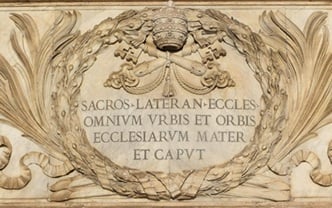 Though he was murdered and buried, Peter’s fame and authority long outlasted Nero. In 313, Emperor Constantine legalized Christianity, and to honor “the Rock” upon which the Church was built, he undertook one of the most significant earth-moving projects of ancient times, moving Vatican Hill over the tomb of Peter, upon which he built the first magnificent church—the Old St. Peter’s Basilica. Everyone remembered that one sarcophagus containing the remains of Peter. This shrine in his honor secured and protected the knowledge of the site for future generations.
In the 1500s, the new and grand St. Peter’s Basilica was built over Peter’s tomb. If you dropped a plumb line from the center of the main dome, it would pass through the papal altar and right down to the bones of Peter.
In the 1940s, while shoring up the foundation of the church, archaeologists discovered a well preserved necropolis, a city of the dead, containing burial places, paintings, sarcophagi, and urns from the first century. They found the marble sarcophagus of Peter with some bones still intact and wrapped in purple fabric. Pope Paul VI announced that the bones of Peter had been rediscovered.
Several excellent books have been written on this subject, and the subterranean necropolis can be visited today under the basilica, with reservations made in advance.
In 2026, we will all be invited on a cinematic tour, spearheaded by actor Chris Pratt, of the archaeological discoveries under St. Peter’s Basilica. We will experience this ancient wonder. This film will doubtless demonstrate definitively how the Church has proved and documented Peter’s presence, martyrdom, and burial in Rome.