




On several occasions, I’ve seen a bumper sticker on an older couple’s vehicle that read, “We are spending our children’s inheritance.” The implication is obvious. They live for their own selfish pleasures, with no concern for or investment in their children and grandchildren.
I did not find it amusing. I found it despicable.
Demographic data show that people live longer now than they did a few generations ago. This means that today, older people are more likely to live to see their grandchildren and maybe even their great-grandchildren. My wife Janet and I are in this category. As of this writing, we have watched twenty-one grandchildren come into the world—and have just welcomed our first great-grandchild.

With some notable exceptions, it was not so in biblical times. Considering the first century A.D.—the time of Joseph, Mary, and Jesus—we see a very different reality. It is unlikely that any of them knew their grandparents (Jesus had only one set). According to longstanding tradition, Joachim and Anna—childless for a long time—were of advanced age when Mary was born.
So it is likely they had died before the baby Jesus became an adolescent. They are never mentioned in the Gospels.
Given the high mortality rate compared to modern societies, the overlap of generations in antiquity was low. Most fathers did not live long enough to see either their sons marry or their sons’ children. . . .
A fifteen-year-old girl—about the same age as Mary is described as being at the time of Jesus’ birth—had, according to models estimating mortality rates, a 62 percent chance that her father was still alive and a 71 percent chance that her mother still lived at this time (75-76).
Life spans were shorter in biblical times, so it’s fitting that God’s promises often involve longer life. Consider the Fourth Commandment, “‘Honor your father and mother’ (this is the first commandment with a promise), that it may go well with you and that you may live long in the land” (Eph 6:2-3). Knowing of life’s brevity, the Psalmist acknowledges God’s blessing of longevity for those who fear him:
Blessed is everyone who fears the Lord, who walks in his ways! . . . Your wife will be like a fruitful vine within your house; your children will be like olive shoots around your table. Behold, thus shall the man be blessed who fears the Lord. . . . May you see your children’s children! (Ps. 128:1-6).
The Israelites were reminded over and over again of their responsibility to future generations. God gave them commands. Continuity should flow not just through the bloodline, but also through knowledge of and obedience to God.
Only take care, and keep your soul diligently, lest you forget the things that your eyes have seen, and lest they depart from your heart all the days of your life. Make them known to your children and your children’s children . . . so that they may learn to fear me all the days that they live on the earth, and they may teach their children so (Deut. 4:9-10).
He also warned that idolatry and sin on the part of grandparents would bring about a different continuity that would inevitably affect their children’s children. It cuts both ways—blessings and punishments. For example, if one couple works hard and earns millions of dollars, it will have an effect on their children and their children’s children. Conversely, if another couple squanders everything and ends up destitute, it will inevitably affect their future generations. It’s the same with the world of truth and moral choices.
Whether we like it or not, our grandchildren, great-grandchildren, and beyond will be affected by our choices. We are all interconnected biologically, spiritually, morally, and eternally. Blessed is the family that has a member interested in genealogy and the family story. A family tree is a marvel to behold. C. S. Lewis wrote:
If we could see the past, then of course it would look different. For there was a time when every man was part of his mother, and (earlier still) part of his father as well: and when they were part of his grandparents. If you could see humanity spread out in time, as God sees it, it would not look like a lot of separate things dotted about. It would look like one single growing thing—rather like a very complicated tree. Every individual would appear connected with every other (180).
Now that we understand our inevitable role in the generational drama, let’s get to the nitty-gritty of the blessings, joys, and obligations of faithful Catholic grandparents. We should think of ourselves as a bond with the past and a catapult into the future, all the while a comforting anchor in the present.
The apostle Paul traveled through the town of Lystra in Asia Minor (modern-day Turkey). A young man lived there named Timothy, who had likely witnessed Paul being stoned by the locals before arising and re-entering the city. He became one of Paul’s most loyal fellow workers until Paul’s execution around A.D. 67. Not only was Timothy impressed with Paul, but Paul was impressed with Timothy, and with his mother, Eunice, and his grandmother, Lois.
Here we have an exceptional biblical account of good grandparenting. Why was Timothy so full of faith and devotion to God? Paul tells us. At the end of his life, Paul wrote to his loyal co-worker, “I am reminded of your sincere faith, a faith that dwelt first in your grandmother Lois and your mother Eunice . . . and how from childhood you have been acquainted with the sacred writings, which are able to make you wise for salvation through faith in Christ Jesus” (2 Tim. 1:5, 3:15). Would Timothy have been knowledgeable and spiritually prepared had he not been influenced so profoundly by his mother and grandmother?
Years before, Lois, a devout Jewess who loved the sacred scriptures had made a conscious decision to be faithful in her devotion to God—and to pass it on to her daughter Eunice and her grandson Timothy. Knowing her Hebrew Bible, she must have been familiar with the Prophet Joel, who wrote, “Tell your children of it, and let your children tell their children, and their children to another generation” (Joel 1:3). It is a recurring theme in Scripture, as the Psalmist sang: “[God] established a testimony in Jacob and appointed a law in Israel, which he commanded our fathers to teach to their children, that the next generation might know them, the children yet unborn, and arise and tell them to their children” (Ps. 78:5-6).
How do grandparents pass the tradition of the Lord to the future generations? Do we just preach at our kids, hammering the truth into their brains? The answer is obvious: of course not. My parents taught me how it is done, and now I see the results, like sap flowing through the branches of our family tree into my own children, into my grandchildren, and even into my grandchildren’s children.
 My father and mother became excited new Christians in 1953. They were on fire, and that flame for Christ burned within them. I was born a year later, and their one stated purpose in life was to live the Christian life vibrantly so everyone would discover the beauty of the gospel. It was not just what they said. It was what they did, what was important to them. If you asked anyone who knew my parents, “What makes Charlie and Frances what they are?”, the universal answer would be, “They are loved by all because of their obvious devotion to God, and they practice the gospel of Jesus Christ!” That was my home, my school, my introduction to life. It was the sap that passed into my veins.
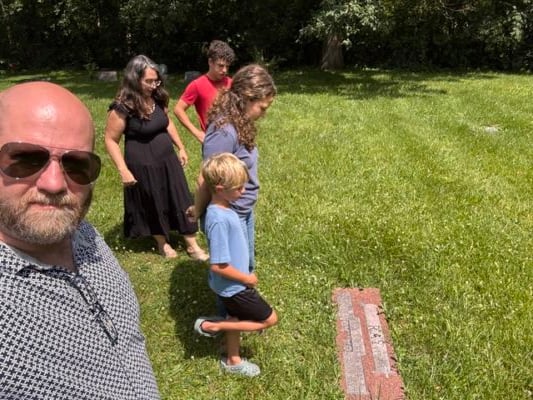
My children remember Grandma and Grandpa Ray and still talk about them to this day, though they have been with the Lord for many years. My son sent me a picture a few days ago. The picture brought tears to my eyes. He had driven way out of his way that day with five of his eight children to visit the graves of my parents—his grandparents. That day, their great-grandchildren heard their story and of their love for Jesus Christ. Prayers were said in their honor and in thanks for what they got started—a love for God and the family. The bond of generations was renewed.
Grandparents can be a light in the lives of their children and grandchildren, long after we are gone. We, grandparents, are an anchor for the family. We have the money and time to invest in the next generations who carry on our name and legacy. We are the historians who help grandchildren know their story and the family traditions. We tie them into the roots of our genealogy as a link to the past. Grandparents are examples of our Catholic faith, demonstrating it through their long-term witness.
“The bond between a child and a grandparent is the purest, least psychologically complicated form of human love,” says Arthur Kornhaber, author of several books on grandparenting. He claims that grandparents can offer an emotional safety net when parents falter. They pass on traditions through stories, songs, games, skills, and crafts. And they have another magical ingredient that parents often lack—time. What many grandchildren appreciate most is the relaxed rhythm of life at Grandma’s and Grandpa’s. Kornhaber has found that children who are close to at least one grandparent are more emotionally secure than other children, and they have more positive feelings about older people and about the process of aging” (388).
Not everyone is blessed with grandchildren, just like how many children are not blessed with wonderful grandparents. Those without this blessing can “adopt spiritual children” and become substitute grandparents to the needy. But that does not diminish the delight when it is a reality.
Watching the new generations grow up around us is better than any Emmy or Oscar. It is summed up well in Proverbs: “Grandchildren are the crown of the aged, and the glory of children is their fathers” (17:6). We are blessed with longevity today . . . so for heaven’s sake (no pun intended), take advantage of it.