




A painful price is paid when you reach your hand into a swarm of bees to swipe some of their honey. Stingers fly, and welts flare.
Wild honey is not collected from wild honeybees without burning pain and suffering. Not for men only, but for the honeybee also—it dies after it stings, because the barbs on the stinger rip it from the bee’s body.
When I was a boy, we had an apiary, which is the technical term for a group of beehives. We had ten hives, and my dad taught me all about tending bees and collecting the honey. But one time, I didn’t follow the careful rules of bee management, and I was stung more than thirty-five times.
I remember when my father built me an “observation hive”—a glass beehive permanently installed in my bedroom. They had a rubber tube through the window frame to enter and exit. We painted a red dot on the queen’s thorax so we could easily find her as she moved about, laying eggs.
Today, we have protective equipment and methods for tending honeybees and harvesting their honey—white suits, facial veils, gloves, and smokers to calm the bees. But it took a manly man willing to endure bitter pain to gain those precious and sweet rewards.
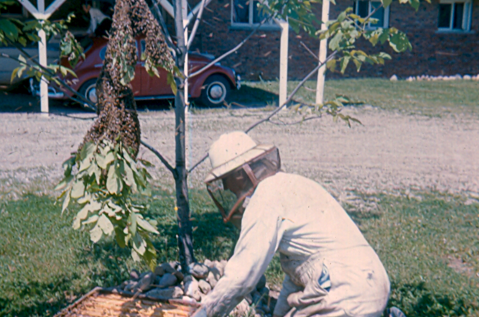
My dad collecting a swarm of bees in our tree.
John the Baptist was such a rugged man. He ate grasshoppers and wild honey, both listed as kosher foods for Israelites. We read in Mark 1:6, “Now John was clothed with camel’s hair and wore a leather belt around his waist and ate locusts and wild honey.” The adjective “wild” indicates that these were not domesticated bees. These were wild bees that aggressively protected their hive and treasure of honey.
In the Bible, honey is mentioned sixty-three times. It was the only available sweetener. (Sugar was not yet known.) How do you think John acquired the honey? Bees build their hives inside a hollow tree or an opening in the rocks. To retrieve honey from these recesses, John would reach his bare hand in, grasp a fistful of honeycomb, and pull it out as quickly as possible—but not quick enough to outsmart the honey bees, who stood alert and ready to defend the members of the hive and their honey. John, like anyone else who decided to harvest that delicious prize, paid a painful price.
There is a general principle we all learn. It is expressed in maxims such as “Good things take time” and “No pain, no gain.” A paycheck is preceded by forty hours of work. Muscles appear after weeks of sweat equity and exercise. Shortcuts seldom pay off, and as another wise saying goes, “If it sounds too good to be true, it probably is.” Achievement takes effort, and rewards are given to those who work hard.
Most people shun suffering and avoid pain. We tend to choose the path of least resistance and seek pleasure, relaxation, and personal gratification. Following these impulses rarely reaps the rewards to which human beings aspire.
The number forty is used symbolically in the Bible over and over again—115 times, to be exact. In Jewish and Christian tradition, forty is a number symbolic of testing, suffering, fasting, repentance, and self-denial. It often precedes new beginnings and new stages of salvation and restoration. Noah’s flood lasted forty days, Israel wandered in the wilderness forty years, Jonah gave Nineveh forty days to repent, Elijah fasted forty days and nights—as did Jesus in the wilderness.
John the Baptist wandered in the Judean wilderness east of Jerusalem. It can easily reach 120° in the unrelenting sun. John wore the scratchy camel hair garments of a prophet (see 2 Kings 1:8, Zech. 13:5). To secure the wild honey, he suffered the pain of harvesting it.
To accompany the honey’s sweetness, he ate locusts, which are a type of grasshopper. You may cringe in disgust, but they have been eaten throughout history and around the world today. It was a food allowed by the Law of Moses, declared “clean” for the Jews (Lev. 11:22). I once jokingly told a group of pilgrims that I “loved living the Bible in the Holy Land,” and if they found a grasshopper, I would eat it as John the Baptist had done. They went on a mission and found a four-inch wiggly grasshopper along the Jordan River. I had no choice but to imitate the Baptist.
In the wilderness, John resembled Elijah, the father of the prophets. They both wore camel hair garments, with a “leather belt around his waist” (see 2 Kings 1:8, Matt 3:4). These are the only two biblical characters mentioned as wearing such garments. John looked and acted a lot like Elijah and was baptizing in the Jordan River at the same location where Elijah was assumed into heaven (2 Kings 2:11). No wonder the Pharisees questioned if John was the Elijah who was to come (Matt. 11:14; see Mal. 4:5).
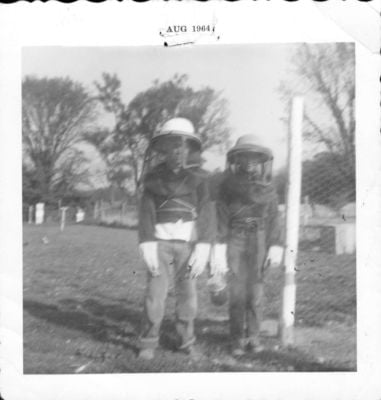
Me with my bee suit, working with the hives when I was a wee young lad!
John was baptizing about twenty miles down the mountains from Jerusalem, about three miles from the ancient community of Qumran. John undoubtedly associated with these devout Essenes, who had moved to the hot wilderness to seek God and become the Children of Light. The wilderness, like the number forty, is usually associated with seeking God and a sincere holiness brought about by self-denial and isolation.
Christian tradition from the earliest times understood the spiritual benefits of established periods of fasting, repentance, prayer, and self-denial. This practice of self-abandonment to the wilderness for forty days has been incorporated into the liturgical year. It is called Lent. The word originates from an Old English word meaning “spring” and was used because Lent, the time of fasting and prayer, was observed in the spring in preparation for Easter.
John the Baptist wandered in the wilderness from his youth (Luke 1:80) to mortify the flesh and earthly desires, focusing his mind and heart on things above. He was seeking holiness and spirituality. Jesus was driven by the Spirit into the same wilderness to be tempted by the Devil and prepared for his ministry. The Church wants us to share in this deeper life of God. Lent is a time set aside so that we can join John in the wilderness—setting aside the distractions of daily life and earthly pursuits, turning to God, prayer, and repentance.
Of course, the wilderness is not an option for most of us since we have families, work schedules, diapers to change, houses to clean, and on and on. The Lord and the Church completely understand. But even the daily service to a family, the quality labor provided on the job, and the extra love shown to others can be acts of penance and self-giving. We can all find time for confession, a bit more prayer, spiritual readings, denying ourselves a few extravagances or pleasures, and seeking to get closer to God. It is never easy—it wasn’t for John, Jesus, or others who wandered for forty days looking for a deeper walk with God and a richer human experience.
We buy honey in the store. A few of us, like John, are willing to reach into a hive and grab the honey at great cost. Like John, we can impose a bit of self-denial upon ourselves, entering into penance, prayer, repentance, and self-denial—though it often feels like reaching for the honey. The minimal pain of Lent can bring about the sweetness of holiness.
These places in the desert still exist. We can walk through the ruins of Qumran, see the mist over the Dead Sea and the mountains of Moab, and stand on the shore of the Jordan River at the place Jesus met John before his forty days of temptation. No prayer or sacrifice, no self-denial or charitable act will go unnoticed by God. The sweetness of the Spirit will certainly be our reward.