




Mary has always been busy. She makes her appearance at key moments—not only in Scripture, but also in recent centuries. It started when an angel visited her, which inspired her to visit Elizabeth. Then the wedding in Cana, the cross, and the Upper Room. After her assumption, we see Mary appear as a great sign in heaven—the queen of heaven, clothed with the sun and standing on the moon with a crown of twelve stars (Rev. 12:1).
An apparition, especially regarding Mary, is a supernatural appearance to individuals or groups at a particular time and place in history. An apparition is considered private revelation. There have been countless alleged appearances of the Blessed Virgin throughout the centuries, but relatively few have been “approved” as authentic by the Church. These approved apparitions include Fatima, Lourdes, Guadalupe, La Salette, the Miraculous Medal, and Our Lady of Champion in Wisconsin.
In most apparitions, Mary speaks. Her message is consistent: to draw people closer to her Son and encourage them to prayer and holiness.
In almost every case, she appears alone. St. Bernadette in France and Juan Diego in Mexico heard and saw only her. The same with Adele Brise in Wisconsin, and the young shepherds in La Salette.
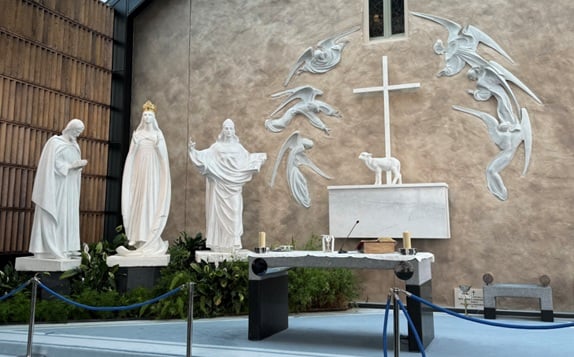
In 1879, in the small Irish town of Knock in County Mayo, fifteen people witnessed something unique: an apparition with several “exceptions to the rule.” The appearance of our Lady in Knock is exceptional in several ways. In this heavenly visit, Mary was not solo, but appeared with a heavenly entourage. And in this case, there was silence. No auditory message was given. However, though she spoke no words, it is apparent that Mary is pointing to Jesus again, especially our Lord Jesus in the Blessed Eucharist.
Let’s set the stage. It was a rainy evening, not unusual for Ireland. Stepping out into the driving rain to lock up the parish church, twenty-one-year-old Margaret Byrne noticed a bright light on the south end. Others had also noticed the uncommon glow. Their heads were down as they pushed through the downpour, so they did not pay much attention. But later, Margaret’s sister Mary was walking an elderly Mary McLoughlin home, and they took a detour to see the source of the light.
Mary became the principal witness of the apparition. The images were moving and not like statues. “Mary was so real,” they exclaimed. One of the fifteen was the elderly Brigid Trench, who approached to kiss the feet of Mary. They prayed the rosary for two hours while the vision remained. During this time, the light was so bright and visible that it was seen by a farmer a half-mile away, who thought it was a fire.
Mary Byrne gave a vivid description of what she saw, which can still be read today. Three figures, appearing at first to be statues, stood near the gable wall of the church. (Part of the old wall has been preserved and can be seen today.) She moved closer and recognized them as Mary, Joseph, and John the Evangelist. Then she noticed an altar upon which stood a lamb and a cross. The lamb was surrounded by animated angels, hovering in worship. The three figures were to the left, and their eyes were drawn to the altar, which seemed to be center stage.
Many years ago, on our first visit to Knock, Janet and I recognized that this was not a “normal” Marian apparition. We perceived something unique about Knock’s images and message. We sat for a long time asking, “What is the meaning of this?”
The image of the lamb on the altar instantly drew my mind to the Book of Revelation. It dawned on us that the curtains of heaven had been pulled back, providing a glimpse into the heavenly reality. It was all based on the last book of the Bible.
Yes, it is a Marian apparition, but with an intensely eucharistic motif. Like in Cana, Mary draws attention to her Son: “Do whatever he tells you!” While visiting Knock, Pope John Paul II made clear that Mary’s direction is ordered toward “Christ in the Eucharist and in the Church.” In a document on the Eucharist, the Vatican wrote, “In more recent Irish history, the image associated with the apparition of our Lady at Knock includes a Eucharistic motif.”
We will look at each image individually, but first it’s good to see the overall scene. On the left are three heavenly visitors: first and nearest to the viewer is Joseph; Mary is in the center of the three; and to the right, nearest the altar, is St. John. The central image abounds with meaning. A small lamb is standing on the altar. Immediately behind and looming over the lamb is a cross. Swirling around the eucharistic scene are a host of angels in flight.
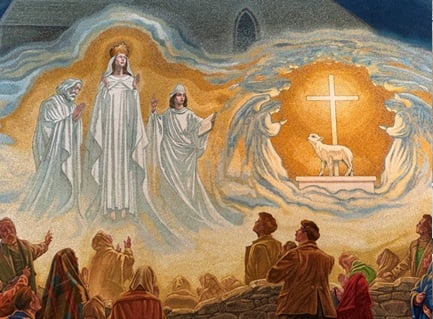
Now let’s break it down before we put it all back together again for our summary.
Starting on the left, we see St. Joseph. He is wearing a white robe, which in Revelation represents heavenly glory, victory, joy, and purity. He is bowing with respect toward Mary and the Lamb, with hands folded in prayer. Jesus is called not only the Lamb, mentioned in Revelation thirty-three times, but also “the Lion of the tribe of Judah” (Rev. 5:5). Jesus is that lion whose lineage comes from his adoptive father, Joseph. Here we see the Holy Family together with Joseph and Mary honoring their divine Son Jesus. There is a pious tradition that Joseph was also assumed into heaven. St. Francis de Sales said, “How could we doubt that our Lord raised glorious St. Joseph up into heaven, body and soul?” Pope John XXIII said the same in 1960.
Fittingly, next to Joseph is the Blessed Virgin. She is the only one not standing with her feet on the ground, but hovering above, as though floating between heaven and earth. Mary is seen in a posture of prayer, with her hands and eyes directed toward heaven. She wears a crown. In Revelation 12:1, we see her in heaven with a crown, and certainly this harkens back to Genesis 3:15: “I will put enmity between you and the woman, and between your offspring and her offspring; he shall bruise your head, and you shall bruise his heel.” She is the woman and now also poses as a mother—queen mother—interceding for us, the Church, in the presence of her Son and the eucharistic sacrifice.
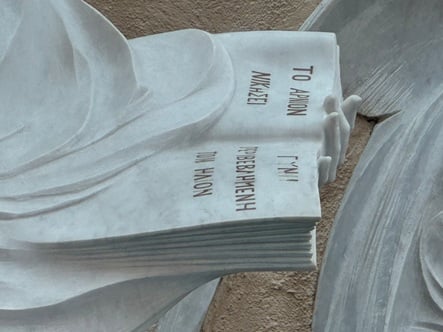
To the right of Mary is St. John near the altar. He is dressed as a bishop in a white robe of heavenly glory. He is wearing a bishop’s miter. Polycrates, a second-century bishop, wrote, “There is also John, who reclined at the bosom of the Lord, and who became a priest wearing the high priest’s miter, and a witness and a teacher.” John holds the word of God in his left hand, while raising his right hand as though preaching.
It is appropriate on many levels that John is in the apparition. He took Mary into his house; he wrote the Gospel of John and Revelation. When you zoom into the words on the pages of the book in John’s hand, we read two texts from Revelation: “The Lamb will conquer (17:14) and “The woman clothed with the sun” (12:1). Powerful words, and certain confirmation that this is an apparition based on John’s Apocalypse.
But how could we miss another rich biblical correlation recalled only in the Gospel of John? He specifically mentions two people who stood at the foot of the cross.
“When Jesus saw his mother and the disciple whom he loved standing nearby, he said to his mother, “Woman, behold, your son!” Then he said to the disciple, “Behold, your mother!” And from that hour the disciple took her to his own home” (19:26-27).
In Knock, Mary and John are seen together again at the foot of the cross. All of the images, motifs, and symbols revealed on that stormy night reverberate with the words of Scripture, especially Revelation.
And lastly, the Lamb, the altar and cross, and the angels adoring. The altar and the cross are together in this vision. The altar is a place of sacrifice and cannot be separated from the cross. In the eucharistic sacrifice, the altar and the cross are one and the same. And why the Lamb, and why is he standing? “The Lamb” is the primary title of Jesus in the book of Revelation, used thirty-three times. Here is the key passage as it relates to Knock:
And between the throne [of God] and the four living creatures and among the elders I saw a Lamb standing, as though it had been slain. . . . Then I looked, and I heard around the throne and the living creatures and the elders the voice of many angels, numbering myriads of myriads and thousands of thousands, saying with a loud voice, “Worthy is the Lamb who was slain, to receive power and wealth and wisdom and might and honor and glory and blessing!” (Rev. 5:6, 11-12).
The Passover lamb had its throat cut, and the blood was drained. Yet this Passover Lamb, though dead, now stands victorious and alive on the altar. This is what God sees from his throne, and this is what we see in our churches—the crucifix above and the altar below. We are not surprised that it is John who wrote of Jesus, “Behold, the Lamb of God, who takes away the sin of the world!” (1:29).
(If you want to see a glorious image of this Lamb in a different setting, yet still standing on an altar, this time with blood gushing from a mortal wound into a golden chalice on the alter, view “The Adoration of the Lamb” altarpiece by Jan van Eyck.)
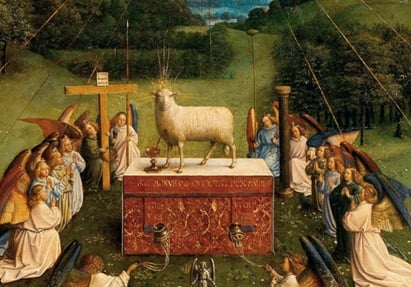
In this magnificent apparition and heavenly vision, we see the Passover Lamb fulfilled on the cross, perpetuated in the Eucharist, and an eternal reality ever before the eyes of God the Father. At Knock, we join Mary, Joseph, and John in gratefulness for our salvation and Our Lord’s continual presence with us through all of time.
As you stand in the Church of our Lady of Knock and observe the Lamb, it appears young, vulnerable, and innocent on the altar. It is looking affectionately at Mary and Joseph, as though to say, “I love you, Mom and Dad! Thanks for your love and for your obedience to the gospel.”
The angels understand all of this as they adore the Lamb. In Revelation we find that angels, cherubim, and spiritual beings are mentioned over a hundred times. So it is no surprise that we end in Knock with the fluttering of wings for two hours in the rain over this revelation of heaven, the Holy Family, and the Divine Liturgy.