




The one thing definitely known about the movie Backrooms, still in theaters, is that if you bring three people to watch it, you will have 400 different interpretations. And counting.
Backrooms‘ story revolves around a hidden, senseless, foreboding labyrinth that exists behind a wall in the basement of a furniture store. The store’s owner, Clark, seems to have enough problems on his hands: getting kicked out of his house, alcoholism, frustrated ambitions to be an architect, and a broken fiberboard peg leg that he wears when he advertises for his store. He is going to a psychiatrist with her own mental issues for help, right up to the point that he discovers these “Backrooms.” From this point on, he, the psychiatrist, and others are ineluctably sucked into the madness and sadness that this place is.
It is The Lion, the Witch, and the Wardrobe for the common denominator of the people we are now: rationalists desperate for stories. It might be also, perhaps unintentionally, the first successful comedy about the nineties. It is also a devastating critique of modern architecture.
To visit this last idea first: although the phrase “liminal spaces” has been used a great deal in articles about and discussion of this movie, the profound unease, from the first shot of the film, seems to come from the lack of human scale in the spaces. It’s rooms that are too large, and designed to be too large, office spaces that are just walls and voids waiting to be modified at the whim of managers into various configurations of cubicles that are too small. Consider the best examples of the modern aesthetic—the Sydney Opera House or Fallingwater.

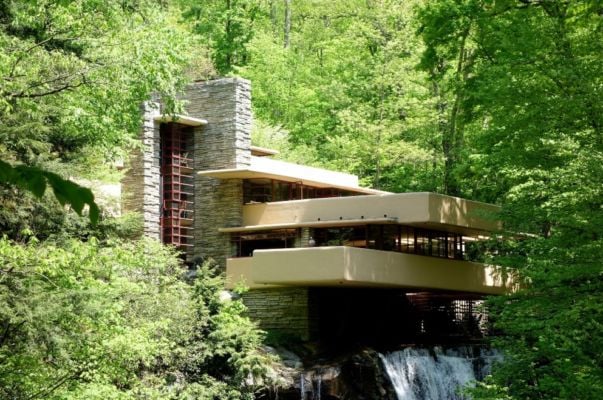
Consider the worst, such as the University of Pittsburgh’s Hillman Library or a building in an office park.
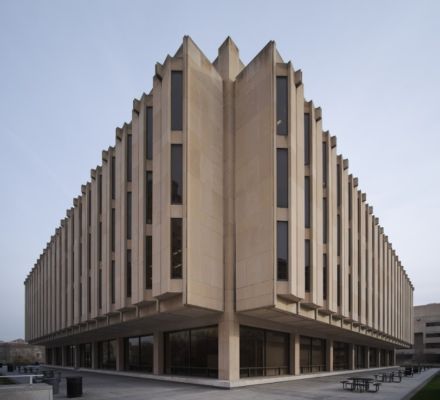
Credit: Dllu via Wikimedia Commons, CC BY-SA 4.0.

What they share is that the buildings, their insides, and the smaller shapes that make them up have nothing to do with human proportions. If this is not clear at first, think of how traditional buildings, such as churches, generally come to a head, like a human being’s shape, or how the insides of older buildings are made to frame human things, like humans gathering for a meal, to sleep, or to worship.
Backrooms is scary not because it is bloody (it isn’t, for the most part), or because of suspense (although of course it features some intense moments of suspense), but because of this profound lack of ease. Human viewers don’t fit into this movie well. The hubris of humans in untethering architecture from the human shape for practical goals (such as office work) naturally results in the spaces becoming senseless, because practicality cannot be an end in itself.
It makes sense that the movie is set in the nineties, since this is the era in which modern architecture reached its exhaustion, leaving the realm of high art to become the default of office building construction.
This exhaustion is a fertile place for comedy. Examples abound, such as the vintage-style commercial for the psychiatry practice of one of the protagonists, Mary Kline, featuring sunset beaches and happy, beautiful people having a garden party. An escape from depression into this “for only $29.99!” Besides beautifully skewering the “As Seen on TV” era, there is all the awkward, barely useable furniture. A dose of humor particularly worth mentioning is the way in which Mary hurts herself while escaping from one of the villains of the movie: clambering over a plush modular sofa, she bashes her shin on the sheet metal frame! If humor’s success has anything to do with collective memories, this is one of the funniest moments in cinema ever.
Most importantly, Backrooms seems to deal with the fact that the interior life is real—even, in a way, more real than the material world. Christians see this truth founded on deeper truths, such as the existence of God and the soul and the eternal significance of a person’s choices. Materialists . . . well, have the Backrooms.
The Backrooms seem like a response to a materialist world’s demand to see truth depicted in story, with flesh-and-blood characters and feelable, albeit faded yellow wallpaper and cheap furniture. In the Backrooms, interior sin has consequences. It not only affects the sinner, but also hurts and even kills other people. In the Backrooms, evil can construct shallow incarnations, petty and mean, and can hurt only by being brutal. Backrooms, like no other movie I have ever seen, reveals the stupidity and meaninglessness of evil. No sinister smart villains from a Cormac McCarthy novel here.
Though a world that refuses belief in God can find a story like this one to portray spiritual realities, it comes at a cost. For one, there is no way out. One becomes either imprisoned in the Backrooms or obsessed with studying them, which the movie implies is the same kind of madness in the end. Furthermore, if the physical brain is our fundamental identity, instead of our being a body-and-soul composite, there is no personal responsibility. Human beings, even their interior lives, really are just a series of senseless spaces and furniture. As Mary is forced to confess to the other protagonist, Clark, “it’s just the way you’re wired, isn’t it?”
Backrooms lifts a mirror up to the viewing public. It might just be jarring enough to wake up a few souls.