



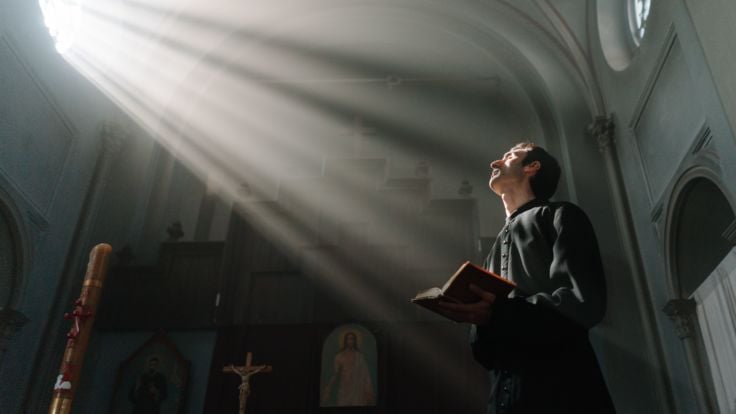
When I contemplate what heaven might be like, I imagine the saints I will meet. What is Moses like? Does Elijah have a sense of humor? Is St. Albertus Magnus as weird as his biography seems? The Church teaches that we remain ourselves, yet perfected through Christ, in heaven, and connecting with others will be a joy we cannot truly imagine yet.
Every Sunday we pray the Nicene Creed and profess belief “in the communion of saints.” The communion of saints is an ancient dogmatic teaching, and since we’re all part of one body in Christ, we should begin meeting the saints in the Church Triumphant while we remain in the Church Militant.
One of the most effective ways to do this is by taking the time to learn the daily prayer of the Church, the Liturgy of the Hours.
While certain religious communities are required to pray the entire Liturgy of the Hours daily, lay people can start just by praying Lauds or Vespers, as we do here at the Catholic Answers office. There are other prayers throughout the day, but being most comfortable with these two, I’ll focus on them.
Both Lauds (morning prayer) and Vespers (evening prayer) contain a similar formula: hymn, then two psalms and a canticle, a reading from the New Testament, a responsory, a Gospel canticle (Zechariah’s or the Magnificat for Lauds and Vespers, respectively), intercessions, and the Our Father. Both close with a prayer, and if there is a feast day, that saint is invoked. It takes about fifteen minutes to pray Lauds in the morning, and another fifteen minutes to pray Vespers in the late afternoon.
Every day when we pray the Hours, I like to imagine we are singing side by side with that day’s saint. We pray Psalm 51 next to Augustine. We pray Psalm 91 next to martyrs like Charles Lwanga. We join Zechariah, Elizabeth, and John the Baptist in singing the Canticle.
In this sense, we connect directly with those in heaven who are interceding for us. Often, I know very little about the particular saint the Church celebrates that day, so it gives me a reason to read and get to know them a little better.
The Hours follow a four-week schedule that accommodates liturgical seasons like Advent, Lent, and Easter, as well as feast days, so those who pray it will need to know the date, the day of the week, and then be ready to turn pages in their book. It’s a little bit like the old “Choose Your Own Adventure” books, where you’ll need to turn to a specific page to find certain prayers, but unlike that series, you won’t end up eaten by ravenous wolves by making an incorrect choice.
Several free apps simplify this and deliver the day’s prayers in a more streamlined fashion. The books tend to be a little more expensive but are built to last many years of prayer.
The Church, being universal, offers us many ways to sing the Hours. If singing sounds too complicated for now, just begin praying the Hours without it. But when you’re ready, start singing! If you’re homeschooling, this is a great opportunity to work music into your curriculum, and if you’re not, it is nevertheless a wonderful thing to sing with your family and friends.
The Church has long extolled the virtues of spending time with good companions. There are no better companions than the saints, who have persevered in God and have won their heavenly reward. The Liturgy of the Hours allows us to spend time with them together in prayer, and we should take advantage of this rich treasure the Church offers us.