



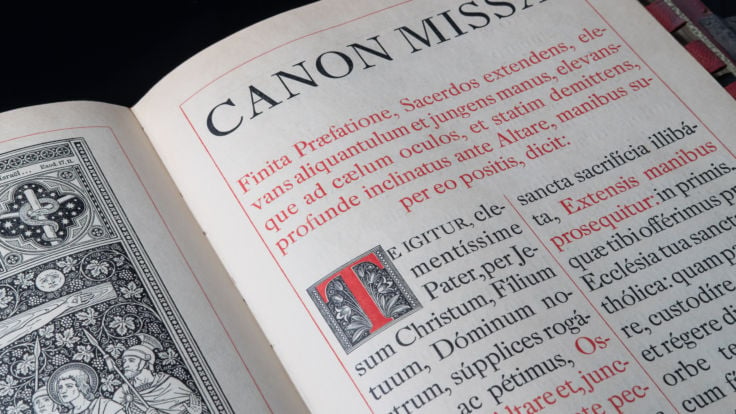
As surely as the sun will rise tomorrow morning, so too will Catholics on social media re-litigate anew the debate over Mass in Latin vs. Mass in the vernacular. The latest iteration of this discourse concerns Catholic unity: does Mass in the native tongue foster greater unity (because more Catholics understand what the Mass is) or does Mass in Latin (because we all pray in one common tongue)?
Far be it from me to attempt to resolve this debate on objective theological grounds; that is beyond my pay grade. But if I must pick a side, I will go to bat for more Latin in the Ordinary Form. There was a time when I would have said the opposite, but one experience changed my mind completely.
Ten years ago, my family made a pilgrimage to Lourdes, France, and it was there that I first experienced the full universality of the Catholic Church. Thousands of visitors from every country in the world filled the grounds of the apparition site. Volunteers and employees wore name tags that included small flags—Great Britain, France, Italy, etc.—for pilgrims to easily identify who spoke their native tongue. The scheduled Masses at the grotto—the very spot where Our Lady appeared to St. Bernadette—were all said, one after another, in different languages. I thought, This is what a worldwide church looks like, sounds like, feels like.
One evening, we joined the nightly rosary procession. In a massive line of pilgrims walking across the grounds, we prayed a multi-lingual rosary—the leader would begin the prayer in his or her native tongue, and we would all finish in our own: “Je vous salue, Marie, pleine de grâce…Holy Mary, Mother of God…” Every decade, we’d switch to a new leader’s language, and every prayer during the rosary procession followed that format.
Except the Our Father.
Every decade started with all of us praying in unison: “Pater noster, qui es in caelis, sanctificetur nomen tuum.” Suddenly, we all spoke the same language, and we all knew what the words meant.
That intrigued me, but I didn’t recognize the full weight of what it meant until later, when we attended an international Mass. There, we made do with similar half-measures to overcome language barriers in the congregation. But then the sign of peace arrived, and I was in a real pickle. How might I “offer the sign of Christ’s peace” to my foreign pew-neighbors?
Almost without thinking, I turned to them and said “Pax Christi.” And something clicked inside my brain.
A universal language lets every member talk to one another. It sounds so obvious, but it took a real, on-the-ground experience to make me see it! No, neither of us was fluent in Latin, but I’m not saying it needs to be a true conversational lingua franca; it’s about opening up these small windows of unity. Every practicing Catholic knows the Lord’s Prayer and the order of the Mass, but when we are also familiar with them in Latin, we can truly say them as one and to one another.
We are indeed a universal Church, and we need not always and everywhere speak the same language for that to be thoroughly, gloriously true. The barrier of language is not an oppressive wall. But a universal language allows us, even for a moment, to reach through that barrier and touch. Why not extend that moment of contact to our full hour of worship—that grand hour when heaven reaches down and touches Earth?