

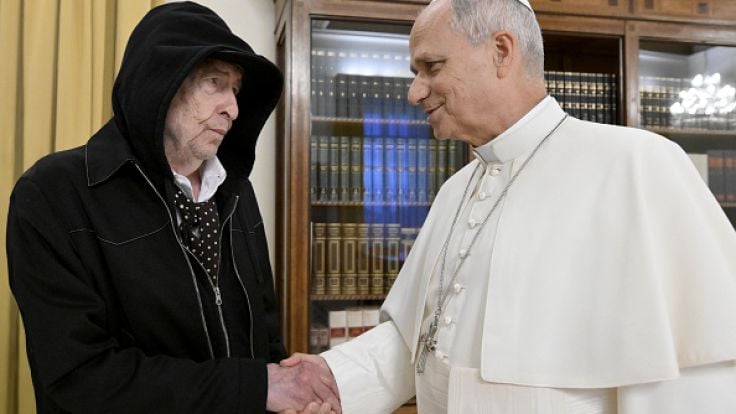
The scene could have come straight out of one of the hooded man’s famous songs. Pope Leo smiles as he shakes hands with the figure, who is dressed almost entirely in black and remains expressionless in every photo. The two men come from such different worlds that the meeting has an air of the surreal, on the order of seeing Batman swapping pleasantries with the Knights of Malta. In this case, however, it was the Supreme Pontiff meeting the Voice of a Generation.
The man in the hood was, of course, Bob Dylan, who is not only a Nobel laureate but, as he was introduced at concerts for several years in the early 2000s, “the poet laureate of rock and roll.” As it happens, the incessantly touring Dylan, now eighty-five years old, was scheduled to play a concert at Rome’s Palazzo dello Sport on Thursday evening, and so on Wednesday, he dropped by to say hello to one of the few people more famous than he is.
The Vatican News story notes that the meeting was “brief, consisting of greetings and a few lighthearted exchanges.” Pope Leo gave Dylan a rosary, and ol’ Bob in turn presented the Supreme Pontiff with a copy of his semi-autobiographical, semi-fictional book, Chronicles: Volume One.
Pope Leo quoted Dylan in the preface to a book that the Vatican Publishing House published, Disarmed and Disarming: Peace Is a Gift, but had never met him before. For his part, Dylan played a short set for Pope St. John Paul II in 1997, at the twenty-third National Eucharistic Congress in Bologna, shaking hands with him afterward.
Still, some people might find it odd in the extreme that the veritable personification of the 1960s-era radical rejection of tradition and search for meaning in all manner of unlikely places would ever want to meet with the Bishop of Rome—no matter how bland and inconsequential the meeting may have been.
Dylan, however, has always been impatient with the idea that he was ever—as, once again, that concert introduction labeled him—“the voice of the promise of the Sixties counterculture.” In a 2006 interview, he said,
You know, everybody makes a big deal about the Sixties. The Sixties, it’s like the Civil War days. But, I mean, you’re talking to a person who owns the Sixties. Did I ever want to acquire the Sixties? No. But I own the Sixties—who’s going to argue with me? I’ll give ’em to you if you want ’em. You can have ’em.
No, thank you.
Along with Dylan’s impatience at the way he has been pigeonholed, there is another very good reason why he may have wanted to meet the pope. By his own account, Bob Dylan is a serious and committed Christian. His 1979 conversion and subsequent recording of three Christian-themed albums (Slow Train Coming, Saved, and Shot of Love) are well known among Dylan fans, and among many who are not. The common assumption, however, is that Dylan discarded Christianity as quickly as he took it up, and that his “Christian phase” was just another bizarre incident in a strange man’s multifacetedly quirky career.
The man himself, however, says otherwise. In 2022, long after he is widely assumed to have left Christianity and never looked back, Dylan said,
I’m a religious person. I read the scriptures a lot, meditate and pray, light candles in church. I believe in damnation and salvation, as well as predestination. The Five Books of Moses, Pauline Epistles, Invocation of the Saints, all of it.
And in 2009, when he released Christmas in the Heart, an album of Christmas carols and hymns sung as only he could sing them, an interviewer said to him, “You really give a heroic performance of ‘O Little Town of Bethlehem.’ The way you do it reminds me a little of an Irish rebel song. There’s something almost defiant in the way you sing, ‘The hopes and fears of all the years are met in thee tonight.’ I don’t want to put you on the spot, but you sure deliver that song like a true believer.” Dylan replied simply, “Well, I am a true believer.”
Although Dylan no longer writes straight-ahead gospel thumpers such as those that populate his first two Christian albums, his later songs are peppered with indications that he continues to take Christianity with the utmost seriousness. In “Goodbye, Jimmy Reed” from his most recent album of new material, 2019’s Rough and Rowdy Ways, he sings “Give me that old time religion, it’s just what I need” and “Thump on the Bible, proclaim the Creed.”
And in “False Prophet”: “Oh you poor devil—look up if you will / the City of God is there on the hill.” In “I’ve Made Up My Mind to Give Myself to You,” he sings, “If I had the wings of a snow-white dove / I’d preach the gospel, the gospel of love.” In “Crossing the Rubicon,” we find this: “Three miles north of purgatory—one step from the great beyond / I prayed to the cross and I kissed the girls and I crossed the Rubicon.” Prayed to the cross, eh?
In 2012’s “Duquesne Whistle” from the album Tempest, Dylan sings, “I can hear a sweet voice gently calling / Must be the Mother of our Lord.” In the 2006 song “Thunder on the Mountain” from the Modern Times album, there’s this: “I been to St. Herman’s church, I’ve said my religious vows.”
Are these autobiographical statements? Almost certainly not. Are they meant to be declarations of the singer’s beliefs? No. Nevertheless, Christian references pepper Dylan’s later work enough cumulatively to leave the impression that the Faith is something important to him.
So why shouldn’t Bob Dylan want to meet with the Pope? In light of Bob Dylan’s convictions, the meeting was not nearly as surreal as it may have initially appeared. It wouldn’t even be surprising if the poet laureate of rock and roll put that rosary Pope Leo gave him to its intended use.
Image credit: Vatican Pool/Getty Images